Visualizing speech in real-time, privately through TEE-backed inference
The Brainrot Box
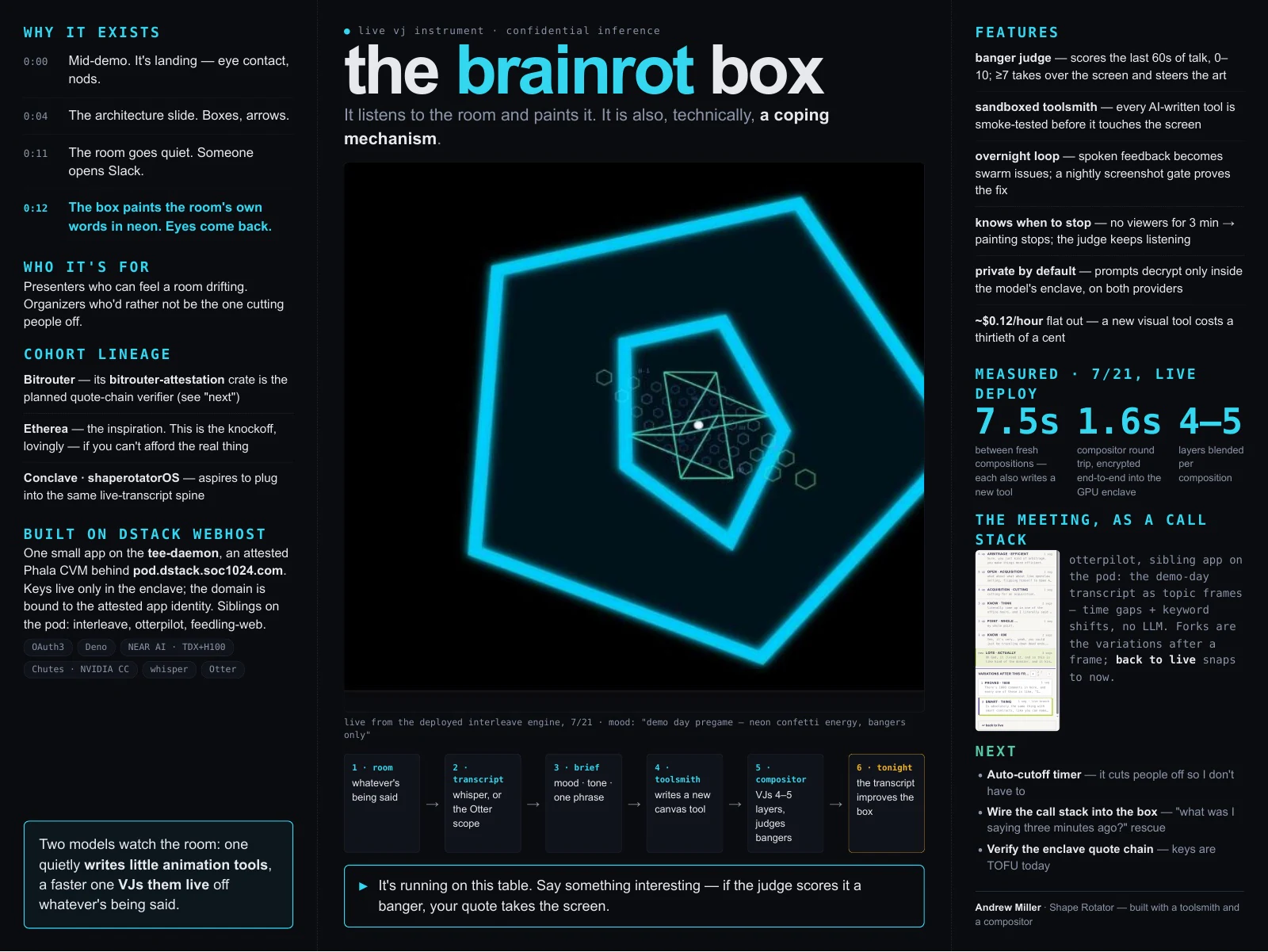
Transforms live meeting transcripts into reactive visuals using private inference and a feedback-driven improvement loop.
Key takeaways
Coding and compositor agents generate and layer transcript-responsive WebGL visuals.
Spoken reactions become GitHub issues that agents can use to improve the next run.
Summary
The Brainrot Box was presented as an experimental bundle for live presentations and meetings, not as a standalone product. It listens to the transcript, changes the on-screen experience in real time, and demonstrates integrations with other cohort infrastructure.
The speaker said inference runs through BitRouter's trusted-execution privacy mode. A coding agent creates WebGL filters while a compositor agent assembles several visual layers.
The prototype can identify a point it considers notable and display a summary. Proposed extensions would help a participant return to unfinished threads or let an agent intervene when someone speaks for too long.
At the end of a meeting, the system is described as sending a Matrix message and harvesting spoken reactions. Negative feedback can become GitHub issues for an overnight agent swarm, making the meeting part of an iterative evaluation loop.
How it works
01
Read the live transcript
The display reacts to the transcript as people speak and flags points it considers notable.
02
Route inference through a TEE
BitRouter processes the live-transcript pipeline through its TEE-based private-inference mode.
03
Generate and compose visuals
A coding agent produces WebGL filters, and a compositor agent stacks the resulting layers for display.
04
Turn feedback into work
Detected feedback becomes GitHub issues assigned to an agent swarm, while a Matrix recap reports what happened in the meeting.
Transcript
But Mom, we have Etherea at home. Okay.
So yeah, if you get that out. So this is the If you're, if you're nice all year, then you're going to get an Etherea, and if you're naughty during the year, then you'll only get a Brainrot Box in the corner. So this is The Brainrot Box. I mean, I'll quickly just say, you know, what this is for me. So I'm a very anxious presenter, and I'm now like have trained myself to have ADHD, so I can only concentrate when there's like shiny things happening in the corner. So this is a presentation tool if you have late onset, adult onset ADHD. It just keeps you distracting. Hopefully, some of you have already been availing yourselves of it.
It's a little redundant when you can just look up and there is Etherea in the background, but just pretend you didn't have that, then this would be extremely helpful. But besides that, this is... So first of all, this is not a product. It's like a collection of research features that might be integrated into many of the projects that you'll see throughout this cohort are transcription-based. And so this is a collection of cool features that might be helpful. You know, if you have presentation anxiety like I do, then, you know, you can see how these things fit together. So besides being a distracting thing, it also does the Etherea trick of reacting in real time to the presentation things that are going.
If I actually move this or dock it outside of the way, you might be able to see a little bit more about what's going on in the corner here. So this is, you know, reacting to the transcripts that are going there, so it makes it sort of interactive. This is then going through TEE private inference, so this is actually demonstrating a couple of integrations with things in the cohort. So Shape Rotation is really about how your project interacts with other projects in the ecosystem. So this is clearly a knockoff or a one-shot, is what we would call it now, of Etherea.
Like, "Oh, I can do Etherea with, you know, 80% of the way with free tokens I have left." But it also peacefully integrates with BitRouter, which is then the, inference provider and specifically in BitRouter's TEE private inference mode. I think that there are a couple of other integrations here. It also shows off a couple of other things that are, I don't know how well you can see it here, but, it detects if a good point is made and then pops up a summary of what the point is. I imagine in the future that what would be really useful is to help me stay on track in a meeting and, remind me, "Oh, you should go back and finish the thread that you tangented.
You know, you're stacked three tangents deep. Go back to this tangent. It's most important." Also, I really hate moderating meetings, so what I really want this to do is to call on people and confront them if they're talking too long. I don't like to do that myself, so my agent should be able to do that for me. The way that it's actually working is kind of fun, which is also just inspired by copying from Etherea, but it's like a coding agent is making these WebGL filters in the background, and then a compositor agent is, you know, stacking them together. And maybe the last feature that I would say about this that's cool that Tina alluded to earlier is that at the end of this meeting, it sends me a message over Matrix about what happened in the meeting.
It actually lets me know that this happened, you know, while the meeting's going. And it tries to harvest feedback. So all of our agents are really busy, and we're in a feedback and evaluation-deprived deprived environment, so you have to extract the evaluation feedback from the atmosphere. So this turns any feedback that's mentioned like, "Oh, that sucks," it will turn that into GitHub issues, and then the little swarm goes and works on this overnight. So it's a demonstration of an improvement loop.
What's, what are the research takeaway parable, but is it, if any, do you like a research insight, takeaway?
The evaluation is so critical. That's the thing that makes it, you know, hard to work. It's like tuned over and over again by collecting feedback, and that was like the whole process of this basically felt like that. Where evaluations start, that's the research