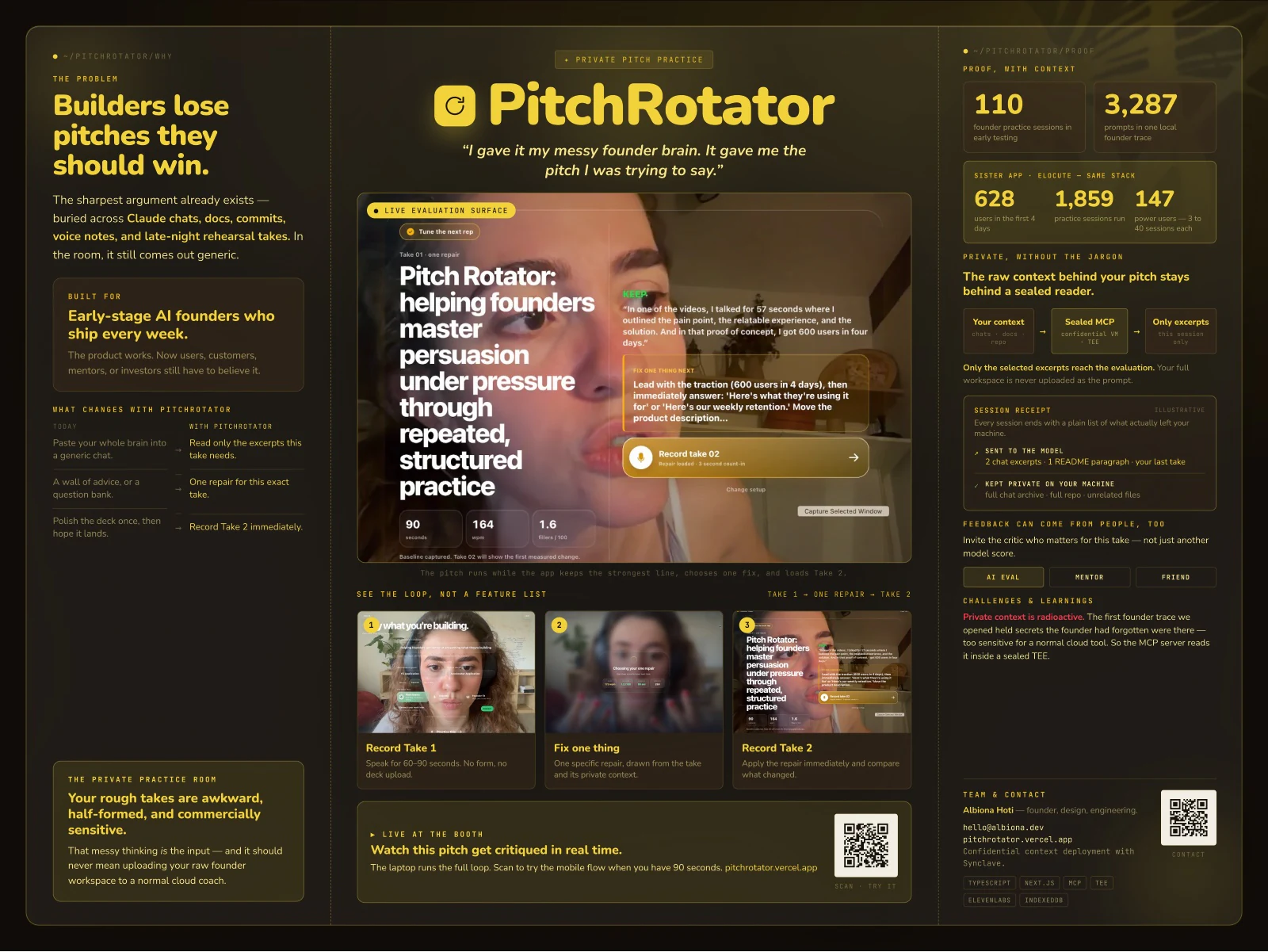
Private rehearsals help founders explain their product under pressure.
Pitch Rotator
Gives early-stage founders a short, repeatable camera loop for practicing their pitch with focused feedback.
Key takeaways
A single camera screen keeps recording, feedback, and repetition in one fast loop.
One strength and one next improvement make each rehearsal immediately actionable.
Summary
Pitch Rotator treats pitching as a skill built through fast repetition. It is aimed at founders who need to explain a product to users or investors and want a private place to practice before the higher-stakes conversation.
The product is organized as one loop on a camera screen. A founder records a short pitch in isolation, receives one positive observation and one point to improve, can share the result for additional evaluation, and then records another run.
The presenter chose a 90-second format and limited feedback because a compact response is easier to apply immediately. She described completing 18 sessions in one sequence and noticing changes in how she explained the product, which remains a personal report rather than a measured outcome.
A proposed private-context layer would connect pitch evaluation to current product information through MCP running in a trusted execution environment. Longer sessions, different feedback depth, and other high-stakes conversation formats were described as product decisions still being reconsidered.
How it works
01
Connect private product context
An MCP deployed in a TEE connects pitch evaluation to current product context from the founder's laptop.
02
Record a 90-second pitch
The founder practices privately in the single camera interface.
03
Return focused feedback
The evaluator selects one strong part of the pitch and one improvement to apply on the next attempt.
04
Repeat or share
The founder immediately records another attempt or shares the result for additional evaluation.
Transcript
Being a founder is extremely hard, and if you're are not willing to iterate extremely fast and apply all of that feedback, you're never gonna make it. After 50 different videos, which I treated each video as a product, I finalized into one little proof of concept that brought me 600 users in five days, and then I thought, "That's it." The words that we put together to then convince a user, an investor, or even sell something to someone are so important. And in order for us to get there, you really need to practice a lot, expose yourself, and get better at doing that.
This is what Pitch Rotator does. It helps early stage founders get better at articulating what they are building under pressure, while at the same time getting all of their private context that lives on your, on their laptops moved to an, through an MCP that is deployed on a TEE so that the evaluation of their pitches is connected to their latest development of the products that they are building. And this way, this whole platform gets to show up as a platform that just walks through the journey of the users. Hi, I'm Albi. This is the platform. Pitch Rotator is going to help everyone get better at presenting and finalize their onboarding of their users or investment and everything like that.
The whole product is one loop. The iteration happens in one screen that is like a camera. You get to pitch yourself in an isolation like this because most of the time we don't want to work in silos and then go out and present it to someone else for them to get feedback for us to get better at it. But you want to do it in an isolation and then notice yourself getting better at presenting as well. And at the same time, you might as well hit those numbers because you will really know when you get to build something great.
It will give one thing that you did very good and another thing that you didn't do good.
It's gonna look like this. It's gonna find your best thing that you said on the pitch, and it's gonna suggest something else to talk better on the next run. And then you have the opportunity to share it with your friends as well to evaluate the pitch, but also, run on the next loop as well.
You said one piece of good and one piece of bad feedback. I'm curious how you ended up at that, level of resolution and if you tried having more, like, more detailed feedback and if that... Like, yeah, why, did you make that choice?
Because it's a product loop, so the iteration happening very fast because the speech is 90 seconds only. And people get tired of reading all of the feedback on their chats right now on the LLMs. And if you get all of that load of feedback, then how, where do you find, what do you apply it immediately, right? What do you, what do you do first? The reason why I did it is because when I figured out the loop, I did 18 sessions in one go, and I would really see that I'm improving my pitch every time I did it, and I would even find new ways of, like, explaining why even, like, this type of product in a way.
Can you increase the time limit of 90 seconds for this evaluation, of Pitch Rotator? 'Cause I'm envisioning, you know, like, if you're trying to pitch to a VC or if you have, like, a talk at a conference or something like that, it'll be, you know, like, 10, 20 minutes, something like that. And if it would be possible to get more detailed feedback.
Yeah, that's all, like, little product decisions, I guess, which I'm planning to redo. I'm getting a lot of feedback on the timing and also on the types of high stakes conversations that are happening, like negotiations of founders and stuff like that. But I went, with the decision, with this decision because you do tend to iterate a lot if you are pitching or trying to convince users to onboard. So the amount of times you practice is way more often than practicing for something longer than two minutes in this case. But yes, open to feedback and suggestions and product angles as well.