Private workspaces let owners share audio, transcripts, and derived insights separately.
Conclave
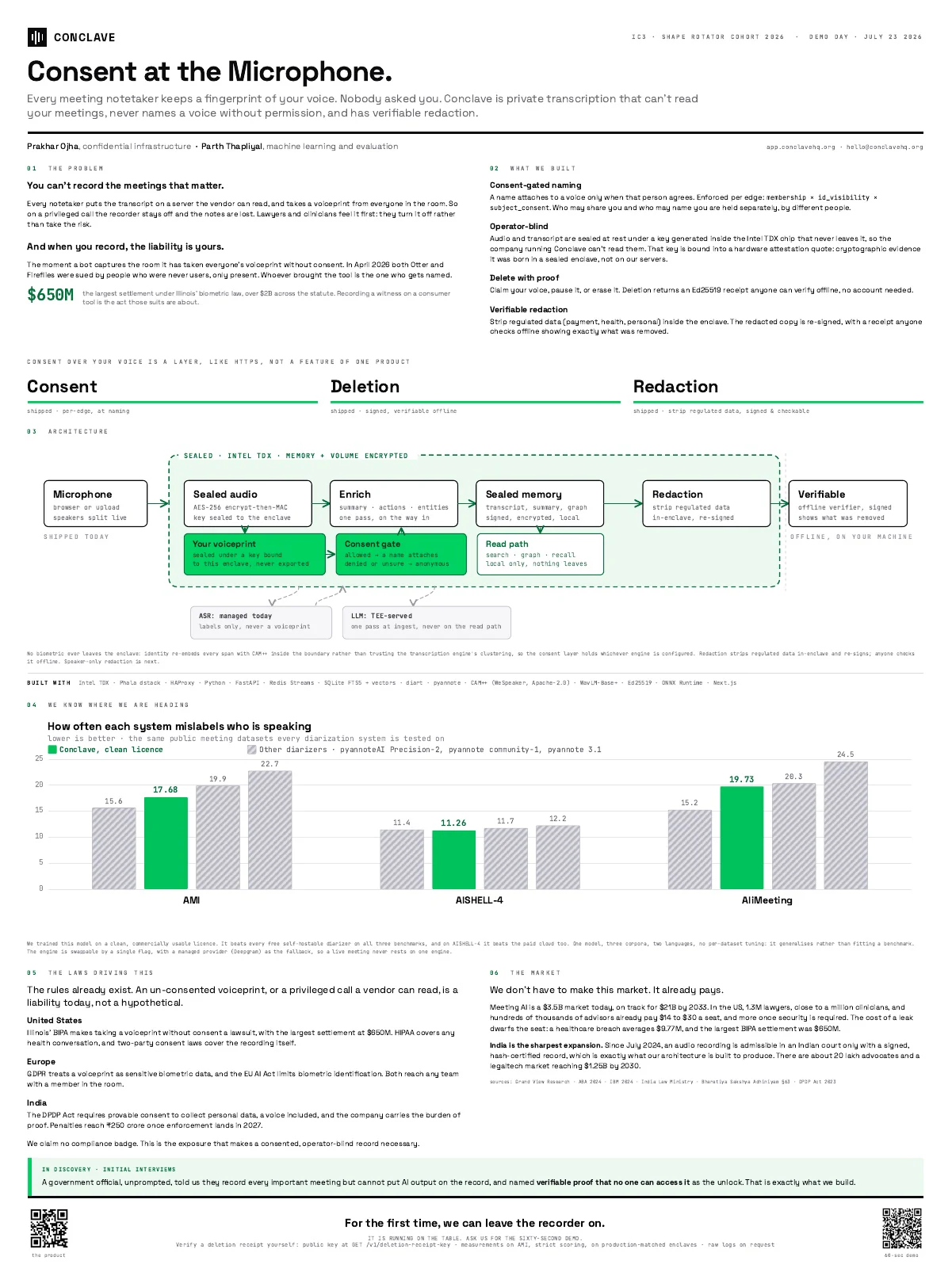
A private transcription workspace designed to keep meeting records, voice fingerprints, edits, and redactions under participant control.
Key takeaways
Version history, hashes, and verifiable redaction make transcript edits inspectable without exposing removed details.
Voice fingerprints inside TEEs require speaker approval before an identity is attached.
Summary
Conclave was presented as a private meeting-transcription workspace. The workspace owner can decide whether collaborators receive raw transcripts, audio, or derived insights, while a recognized participant is asked to approve the association with their voice or stay anonymous.
The proposed integrity layer combines editable transcripts with version history and hashes that expose what changed. A separate redaction flow is intended to remove accidentally disclosed personal details while leaving a verifiable record of the edit.
The team said privacy concerns surfaced during conversations with government officials in India and described confidential government meetings as a target market. That remains a stated direction: the presentation also described the demonstration workflow as newly assembled and still being patched.
How it works
01
Create a private workspace
The owner separately controls who can access the audio, raw transcript, and derived insights.
02
Verify transcript changes
Planned version history and hashes would show which transcript passages were edited.
03
Confirm speaker identity
The proposed voice-fingerprint flow would run inside a TEE, and each recognized participant could approve the identity tag or remain anonymous.
04
Redact sensitive details
The user can remove sensitive material from a recording record through a redaction flow intended to remain verifiable.
Transcript
I'm Prakhar, and that's my teammate Parth, patching something live right now, and we're Team Conclave. And just to be clear, I see, like, a lot of cameras right now, and I'm assuming all my audio is getting recorded, which kind of scares me because I don't like being recorded. That just means that anyone can hold up to me that what I'm saying or what I'm, you know, what I'm displaying right Shh. Okay. What I'm displaying right now, and a bunch of my lawyer friends feel the same thing, which is basically for them, if they're having a call with any privileged client, having a third party in the call is kind of a no-go for them.
And not just lawyers. And that's just not it. Every meeting note-taker app that you use right now actually stores your voice fingerprint without your permission and your consent, which is a really big problem if you think about it. Most of the government officials actually place your voice fingerprint somewhere between one thousand dollars to five thousand dollars. So that's something to think about what you're giving away for free. And that's why we built Conclave, which is private transcriptions in your own hand that you can use in any room and, you know, tag people with their consent. Some of the things that I just wanted to highlight is all the meetings are private by default, so all the workspaces, people that, you know, you wanna share to, you can choose whether you wanna share the raw transcripts, the insights, the audios, and everything.
Everything is configurable. Every recording is actually editable. The transcript itself is kind of editable. And, just to be clear, we are creating transcript versioning kind of like people who know get. So in case someone edits your, you know, what you're saying, you can actually verify if what part they edited and what was the hash, and so on and so forth.
We also have something we are calling VFTE, which is voice fingerprints inside TEEs, which is, if you get tagged, through your email, you get a mail saying that, "Oh, you were recognized in this workspace, and now you have to approve it." Or you can choose to stay anonymous. So it's all up to you, and your voice fingerprint is what you control. And the most, I'd say, the highlighted feature would be verifiable redaction. So when you're speaking something freely in a recording, you maybe accidentally tell your date of birth, your Social Security number, not exactly your Social Security number, but maybe some other private details, and you would want them redacted. So we have that feature built in.
And, why get into this? So we were running through a lot of validations, and especially in India, and we found out a lot of government officials actually don't use, transcription bots, mainly because of the privacy reasons. And that's what we're trying to aim into and lean into. So the aim is to have, you know, all the governments basically use Conclave for recording all their meetings, deriving their insights, everything confidential.