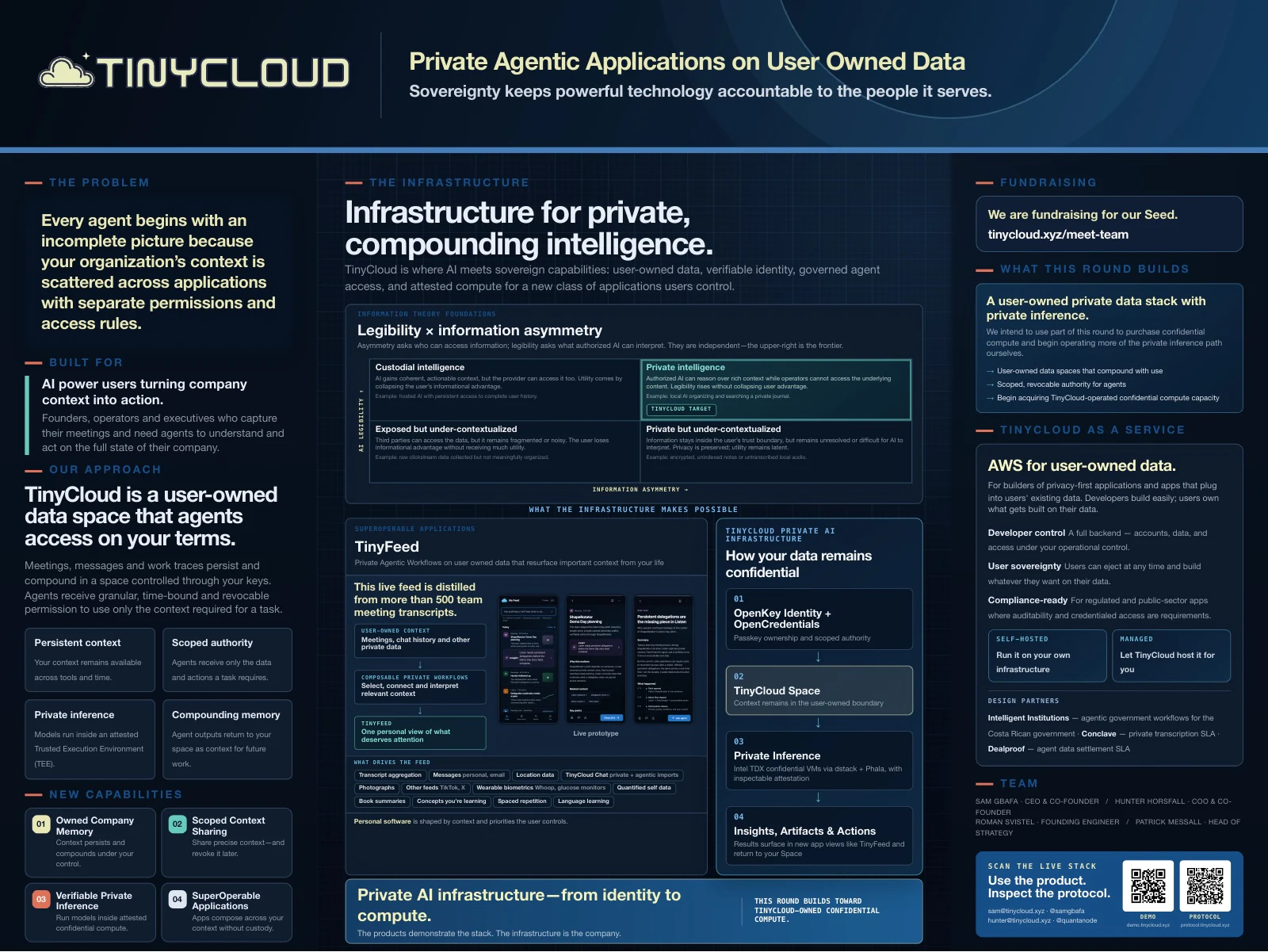
The core design replaces platform custody with user-owned data spaces and explicit, signed permissions.
TinyCloud
Builds infrastructure for private agent applications in which users retain ownership of their data and grant apps limited authority to use it.
Key takeaways
Data can stay on a user’s device or be hosted by an infrastructure provider they choose.
Portable agent context lets users leave an application without leaving their data behind.
Summary
TinyCloud frames private agent infrastructure around data sovereignty. Instead of placing a user's records inside an application's account, the user creates a data space and signs permission for an application or agent to perform a requested task.
The proposed stack starts with a protocol layer that can be hosted by the user, TinyCloud, or a partner. Higher layers expose permissions to applications, while the stated business model lets an organization use the service as infrastructure and gives the end user a path to take direct control of their data.
The speaker said the team had built three applications for a customer and was raising capital. A recorded product walkthrough presented portable chat data, passkey access, user approval before agent actions, and restrictions on platform access or model training; these remain presentation-time product assertions.
How it works
01
Create a data space
The user stores data in a space they own, hosted on their device or with a provider they choose.
02
Sign a scoped permission
The user signs a message granting an application or agent authority for a requested task without transferring data ownership.
03
Operate through the permission layer
Applications and agents use those permissions to work across only the data the user has authorized.
04
Approve every action
A passkey unlocks portable data; an authorized agent creates briefs, insights, and proposed next steps, but nothing executes without user approval.
Transcript
I'm Sam. I'm the founder of TinyCloud. At TinyCloud, we're building infrastructure for private agentic applications on user-owned data.
So why would you trust OpenAI or Anthropic with everything, right? As we heard earlier, you don't want to end up in Peter Thiel's bathtub. Maybe you want to think about the information you're giving them, right? If you're capturing everything you're saying, if you're using newer technology like a brain computer interface, maybe you don't want to hand over the keys to that. Best case scenario, you're really locked into an ecosystem that you can't escape. Worst case scenario, you're manipulated in ways you can't comprehend. So the solution for this is actually a different model. It's actually sovereignty. Sovereignty lets lets powerful technology serve the person who's using it. So that's what TinyCloud enables. With TinyCloud, you grant control you grant authority over your data, by giving permission to something.
So apps or agents don't own your data, you do, and you just grant them permission. You create a space, you sign a message to give them permission, and then they could use that permission to do whatever you're asking them to do. TinyCloud is a stack. The very bottom is the protocol layer. This is like where your data lives. You give access. You can host your data on your own devices. You could host it with us. You could host it with Synclave, who's a partner. We have many components on top of this that make TinyCloud easy to use, and this kind of creates what we call the permission information surface. On top of that surface is our super operable apps.
It's like short for super interoperable. These are apps that can access all your data with your permission to create really novel and amazing experiences. While we've been here at Shape Rotator, we've encountered, really awesome teams that are thinking about building for sovereignty, building for privacy, and there's kind of a common shape of problem. For example, Conclave, they have private transcriptions, but well, is the data really private at the end of the day when after you pass it through? The same with, Sanctum. They're doing voice journaling. And DealProof, which we'll hear about later, they're doing agent-to-agent negotiations on private data, right? How do you keep the data private? This is a hard problem that we have a lot of experience with.
So we've really been thinking about TinyCloud as private AI infrastructure as a service. You can think about this as Supabase for sovereignty, right? So it's kind of a B2B2C product. At B2B, you can just you can use it normally, like a, particular database, but your user can eject. They can say, "I'm taking control of my data." And then they can actually become a customer of TinyCloud. So TinyCloud, we have a customer we've been building for. We built three apps, and, actually we'll show you a little video of how it works.
Your chats, your meetings, your decisions, the most personal data set on Earth living on someone else's platform. TinyCloud Chat keeps every conversation in a space you own. Synced, portable, never trapped in a provider's account. Now connect your feed. One passkey. Only your key opens the door. Behind it, an agent you own goes to work reading transcripts, finding threads, drafting what matters. It comes back as your feed, briefings, insights, artifacts distilled from your own words. It even proposes the next move. But nothing happens without your approval. No platform reads it. No provider trains on it. No silent logging. Only your key. And the feed? Just one app. When data travels with you, not a platform, wild new experiences become possible.
TinyCloud, private agentic applications on data you own.
We're currently raising, And yeah, we think really about sovereignty. Recently Palantir pivoted to focusing on sovereignty for governments, AI sovereignty. We focus on people and organizations.