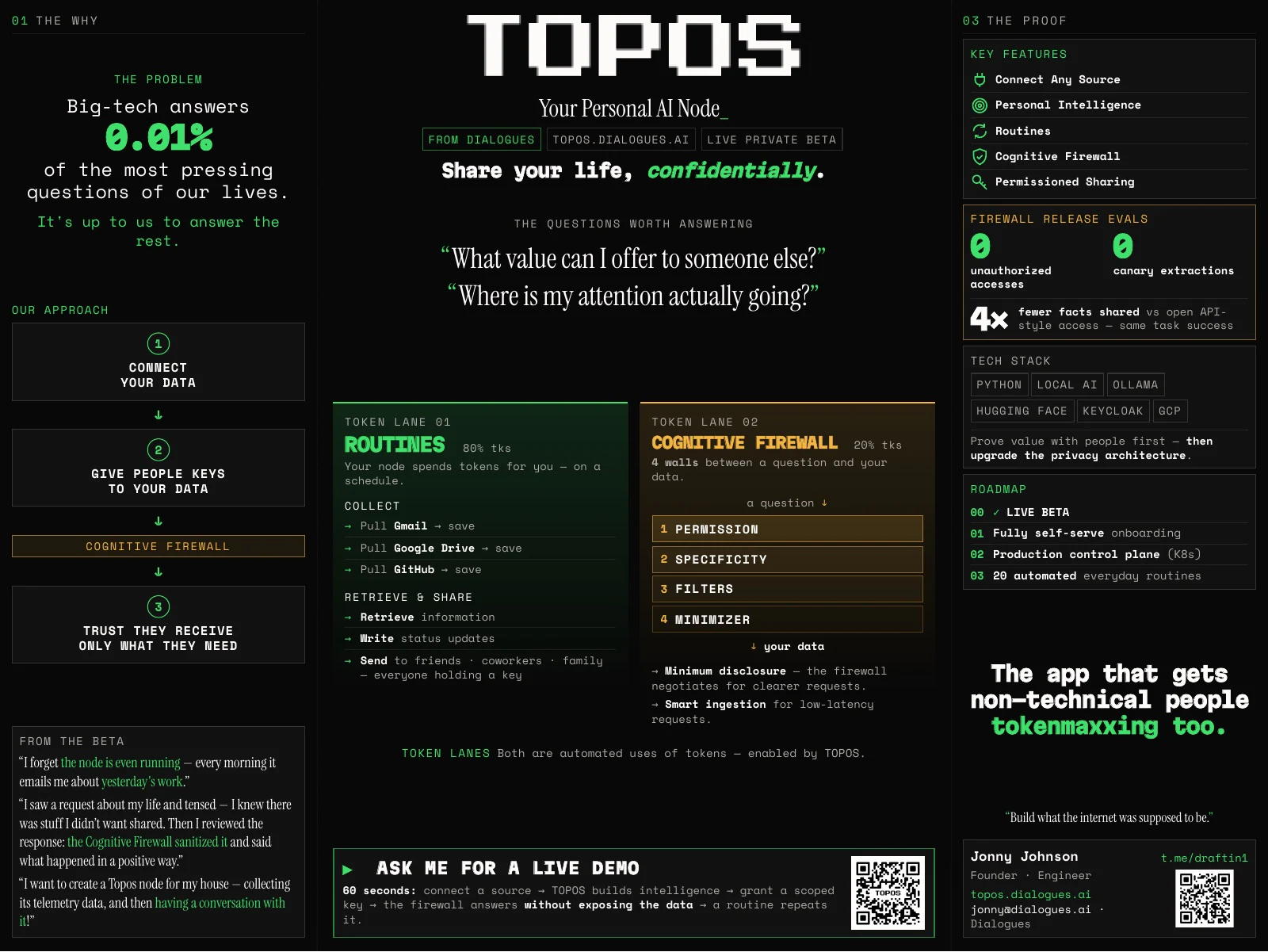
A local personal database combines data from applications, files, and custom sources under the user's control.
Topos
Local-first personal database that turns private data into useful signals with controls for how agents access it.
Key takeaways
Personal data can produce both private intelligence and minimized signals for selective social exchange.
A cognitive firewall checks access, specificity, minimization, and disclosure boundaries before sharing.
Summary
Topos shifts personal-data intelligence away from a company's narrow commercial objective and toward questions the individual chooses to ask. The presented first step is a local install that can ingest applications, uploaded files, and custom data sources into a personal database.
The system distinguishes two outputs. Personal intelligence captures entities and relationships in a knowledge-graph-like structure, while a second class of derived signal is intended for communication among personal nodes.
Making the node multiplayer creates a disclosure problem: a useful request should not automatically expose everything stored locally. The presenter described a cognitive firewall that first checks access, then challenges vague requests, narrows the relevant time or scope, minimizes facts, and controls what crosses the boundary.
The presenter said Topos was available at the time of the talk, but this review did not independently verify deployment, predictive accuracy, or the security properties of the firewall. The architecture should therefore be read as a presented design and status report, not as an audited privacy guarantee.
How it works
01
Connect local data sources
Install a local node and ingest data from applications, uploaded files, and custom integrations.
02
Build a private knowledge layer
The node organizes ingested data into personal entities and relationships for user-directed analysis.
03
Derive a shareable signal
The node derives a separate signal from personal intelligence for communication with other personal nodes.
04
Apply the cognitive firewall
Each request must pass access, specificity, minimization, and output-boundary checks before information is returned.
Transcript
Hi, my name's Johnny. I build Topos. There was a story that went around like 10, 15 years ago, kind of in the, emergence of all the data collection going on, where a dad got a, an advertisement from Target, saying that or sh-sh-sharing, information, that was targeted at his daughter, saying that she was pregnant. And she was like, "What is, what is this kind of information I'm getting? This doesn't make any sense. Don't, don't be sending this to me." And, he went and found out, and it turns out like she was pregnant and hadn't told him yet. And what the problem this is like going towards and illustrating is just that there's intelligence that companies have and, there's ways that they act upon it that aren't always in your best, interest.
And really, it's like if there's that kind of intelligence that is known, then what, what are the more appropriate questions that you could be asking? And what are the limitations in which the companies, are forced to ask it? Because it's within their business function in terms of Target to, surface that information and try to sell you something that you need, when she, you know, could be better off having support. So they have this intelligence, and then, companies then are only answering a fraction of the kinds of information that's really relevant and important in our lives. So, it's our responsibility to start answering the rest. And what's cool is that now we have the capability with just, the, LLM processing and the information, processing abilities of the LLMs.
All of our like MacBooks or whatever computer you're using, the infrastructure like locally is a lot better. Here, this cohort's even building some of the sovereign infrastructure that this can be built on. So we have the possibility, and like I think our needs as a society have surfaced and outgrown the things that, the corporations and institutions are actually providing us. So like we, also have a responsibility. We have needs that need to be met and a responsibility to start, doing something about them and for them. And so what I've, what I've done is, created Topos, and it's a personal database so that you can collect your own data. You can run that kind of data intelligence that, could surface your behavior data and start predicting kinds of trends going on in your life.
And the first step to it is one, one install. And all of this has been made and it's going to be is available. You install something locally on your device. You can collect any kind of data that you might be interacting with. So here we've got apps, file uploads, build your own custom, custom applications, just vibe code something, and connect it. And then what ends up happening is that you ingest that data, and there's basically two classes of information that we want to collect. And the first one is a bunch of personal intelligence, so, building out like some knowledge graph kind of stuff. And then the second one is creating signal. Because what ends up being cool, I think, is now, now that we all have our own personal node, we, want to start communicating with one another and have that kind of information of like the social network type of information.
So we end up getting signal, derived from it. So our Topos Node is multiplayer. Multiplayer brings up then the problem of like, okay, well if I'm storing all of my data on it, like how do I know like stuff's not being shared to someone else? So we have a privacy problem, and to that, I've built then a Cognitive Firewall. And this Cognitive Firewall has like four different layers to it. First is just the easy one of access, like can you access it? Like, do you have a key to my database or not? And then it goes through another level of like three filtering process. So there's a, there's a step for specificity. We actually have like there's a built-in like an AI agent that's making sure that the requests that are coming in aren't vague and not, Ma-make sure that you're specific and that certain information is going to be, come out better.
So it's like, do you need, five weeks of data, or do you need one day worth of data? And, argue against that. So then filters are another type. Minimizing is the amount of facts that are coming in. Because we have we're setting the boundary and creating this boundary with the firewall, we know, too, the kind of information that's stored within your database and then the kind of information that it's, returning to upon request. So this is built by me. I've got a partner named Mitch. I guess we go for some alliteration in our names. Worked with some sales, sales consultants. I have a really strong like I was like a M&A advisor for a little while.
Accounting, financial expertise, and then have had multiple contributors, along the way. And then Topos is the product. It's, available now, and you can come and chat with me later.