Account pooling and automatic switching can keep agent workloads moving when individual subscription limits are exhausted.
LLM Account Pooling and Token Subsidies
The talk treats premium-model subscriptions as a temporary, heavily subsidized bridge for continuous agent workloads and proposes owned, metered compute as a more durable foundation.
Key takeaways
Human-oriented usage limits, provider controls, and revocable subsidies make consumer subscriptions too fragile for production dependence.
Treat compute like electricity: own capacity, meter consumption, and sell forward access to unused capacity.
Summary
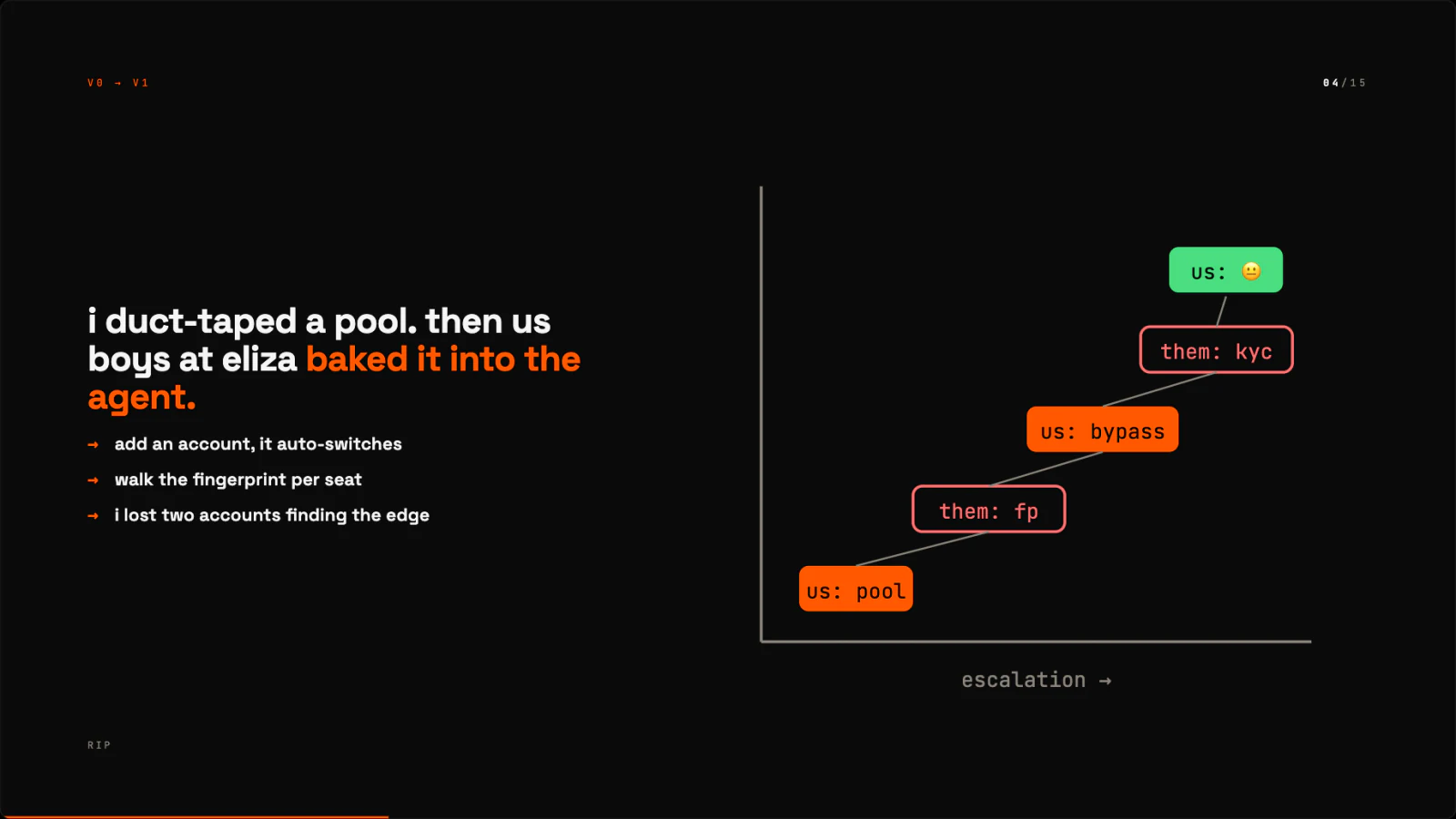
The project began with an operational problem: one premium account could not sustain a continuously running agent swarm. Multiple accounts created login, reset, and context-continuity overhead, so the team built account switching into Eliza.
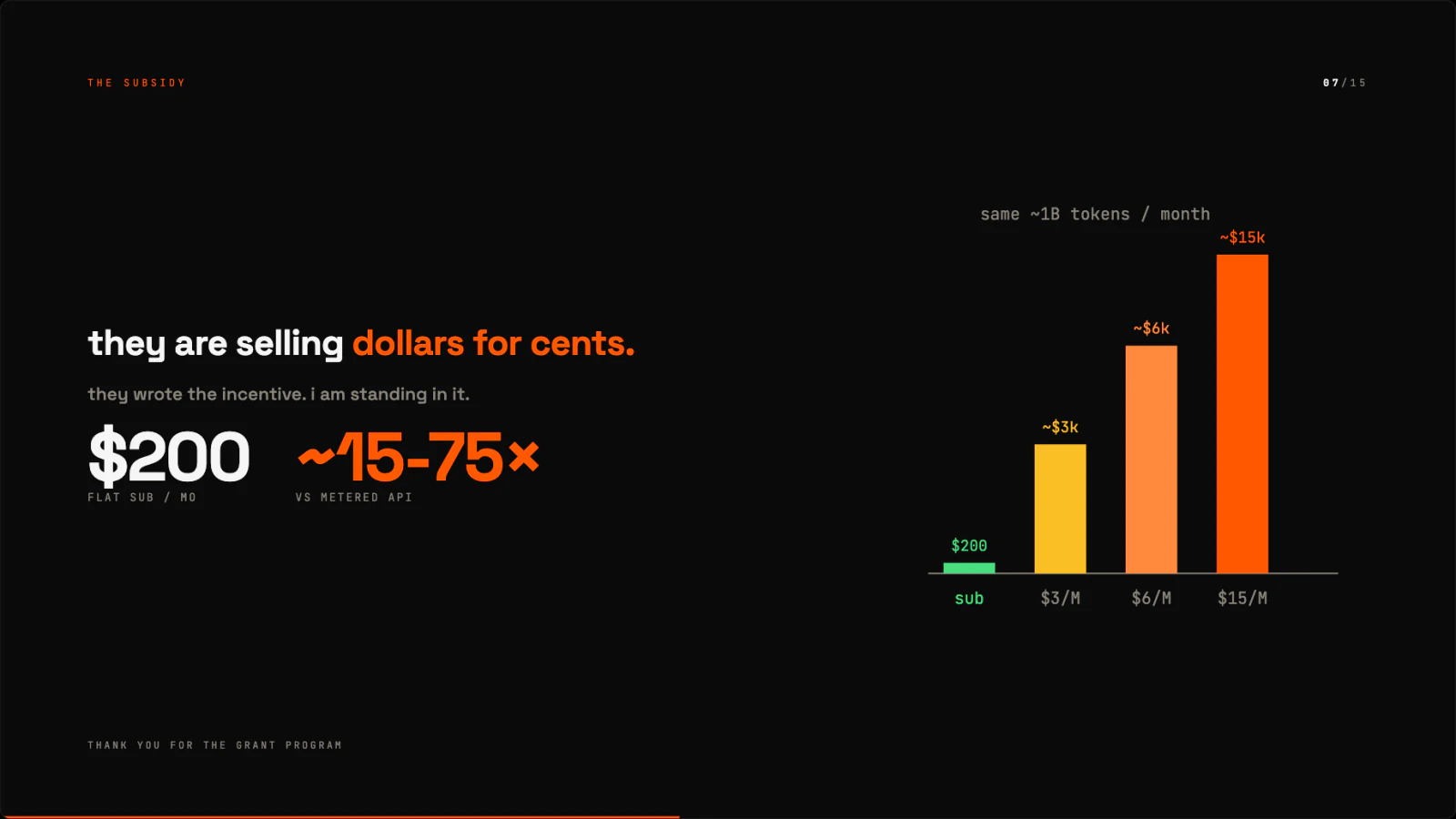
The speaker characterized current subscriptions as deeply subsidized and designed around human work patterns rather than agents operating around the clock. The deck and talk present this subsidy as economically attractive today but structurally unstable.
The risk is not only price. The speaker pointed to identity checks, device fingerprinting, account bans, and the possibility that providers could withdraw the subsidy, and therefore cautioned against building a company on the arrangement.
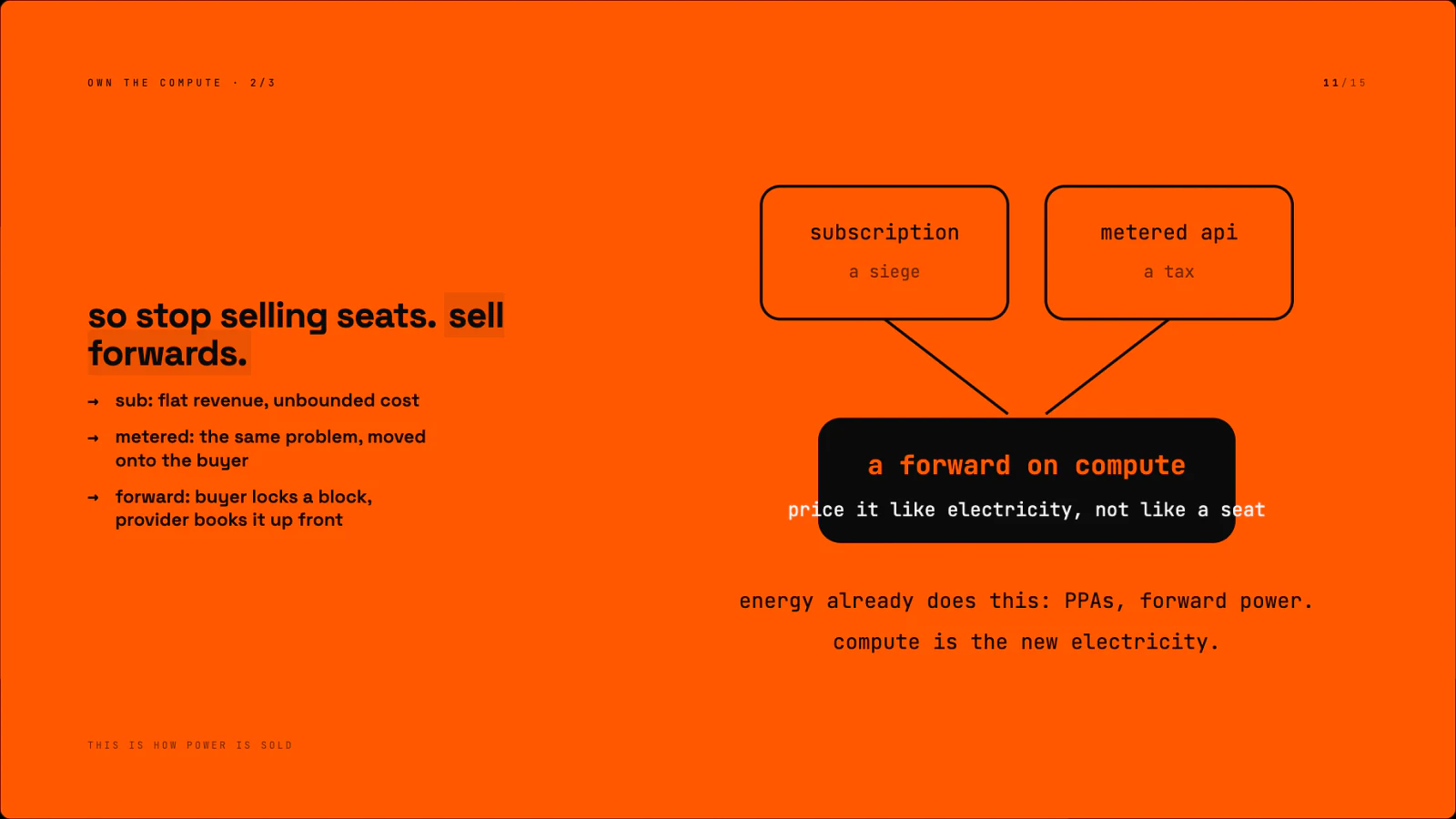
The proposed long-term model is to treat compute more like electricity: own a block, meter what is consumed, and sell forward access to the remainder. Idle capacity could then be directed toward compute-intensive research, formal verification, or security work.
How it works
01
Switch accounts at usage limits
The switcher orders subscriptions by their weekly resets and moves the agent workload when the current account reaches its limit.
02
Replace subscriptions with owned compute
Continuous agent workloads move from human-shaped subscription windows to compute capacity that the operator owns.
03
Meter use and sell the remainder
The operator consumes the inference capacity it needs and sells forward access to the unused portion.
04
Put idle cycles into verifiable work
Idle capacity can run formal verification, security testing, or compute-intensive research instead of generating disposable content.
Slides
Transcript
So how many of you have a two hundred dollar Max subscription? Show of hands. Okay, more than one? Okay, five. Okay. These people are tokenmaxxing because right now there's a huge subsidy on tokens from the big labs. You get up to, like, ninety-nine percent, subsidy from the labs. So I, had a problem where one Max subscription wasn't enough for my swarm of agents, so I had to figure out, how to get more tokens, so I ended up buying more accounts. But then that led me to a problem of, account switching. I had to keep a track of how many accounts I had and, you know, switching them, logging in, logging out. So this was a huge pain point.
Another reason, to do that is, whenever an account ends, I'll be sleeping and my agents will be working on some project, and it'll stop and all the context is lost and switching the context, that's another huge issue too. So what we figured out was, yeah, we just have to create an account switcher, so that, we can switch between the accounts efficiently. So we had a Eliza built-in, account switcher. Shout out Nubs. And, so that was the first problem solved. Okay, yeah, we have like ten, twenty, thirty accounts, but now what's the next, level of defense in this arms race? So then, Anthropic and OpenAI, they, started, you know, KYC-ing us. So this is literally Anthropic asking me for my KYC to let me give them money, and this won't, work out.
I would never give my ID just to get some, subsidized Fable tokens. Like you can see here, this is our account switcher. I have eight accounts loaded up, and they're sorted by the weekly reset so that I end up using up all of the accounts, by their weekly reset. This is, Yeah. So how are they able to do that? If you count the amount of tokens they're giving us, it's something like one to two billion tokens per Max account. And the way they're, doing it, they're giving us fifteen to seventy-five times the value. And, so this is not sustainable. Like open source models, they cannot, compete with this. And it's built for a primitive where there's like a five-hour hour weekly, a five-hour, limit and weekly limits.
So it's built for humans, not for agents that are working around the clock. It's built for the, you know, the worker's weekday. So this is, this is a, this is not sustainable. But another point I want to, show is, like open weights are free, but people just say like, "Yeah, just self-host and run your own model." But doing that, like let's say I want to run a Kimi K three, with, you know, two point eight trillion, parameters. Let's say I run it on four-way quantization. I need like eight V300, GPUs. That'll cost me something like forty to fifty K. And the only way I, get the maximum efficiency out of it would be if I was batching it and, running it twenty four/seven, and even then it'll cost me something like one to two dollars per million tokens compared to something like twenty cents for, a subscription.
So I would not build a company on top of this. Like this is a good bridge right now to, max and build products, but this is very unsustainable to build a company. Because let's say I want to run an enterprise, you see companies spending fifty thousand, a hundred thousand on subscriptions, and then there's always the risk of, Anthropic already does a device fingerprinting, and there's like b-ban waves, especially for people from other countries like China. Like recently, there was a huge ban wave where, you know, hundreds of thousands of people got banned in some countries, and the subsidies might just stop one day. So this is not sustainable. So how do we fix this?
So we stop selling seats, and we sell compute forwards. We have GPUs, and then, we sell compute forwards to people. And then, right now we're treating these like gym subscriptions, but I feel like a compute is more like electricity. Like I feel like the power companies already solve this with, power purchase agreements, you know, forward power, and I feel like compute is the new electricity. So the best way to do this would be to own the compute, use whatever we need, meter it, and then resell the rest.
So okay, yeah, you're not reselling the rest. You have all of these compute. Let's say you have an NVL seventy-two, you have so much compute, you're running the best frontier open source model. How do you use this? One way we were using this is through, using our compute to solve math problems. So we used, formally, verified lean to solve something called as a proximity prize, where the, agents prove a lemma or they don't. They solve the math surrounding the problem. To try to get to the problem. We can do the same thing for finding proteins, all sorts of decentralized research swarms, and, we can just, use it. And research research burn is very bursty, and, this is perfect for using idle compute.
So this is one way of, using the excess compute. But yeah, so ideally, we, need to figure out a way to, move on from this, subscription, subsidy paradigm and figure out better ways to get more compute because the tokens will be, you know, commoditized.
You could try to just directly resell more generic like inference. But instead you were talking about doing specific tasks. Can you tell me more about the sort of separation between those and why you ended up on specific tasks?
So we can, we can Look, reselling the compute that's subsidized, it's against EOS. So the only reason I mentioned specific tasks like decentralized, research is because let's say you have a lot of idle compute, and you want to use it on something, you cannot just create a whole bunch of slop and just, you know, flood the internet or something. So a better way to, use that idle compute would be to solve, research problems which are, you know, token, intensive. And, you can even use it for things hardening your systems, for example. That's another use case. You can, run a swarm of agents just trying to exploit a system. But I wouldn't want my agents to continuously just posting on Twitter or making slop blog articles.
So a good way is to, use them to do formal verification or something, you know, noble.