Fast re-entry turns fleeting ideas into actionable threads, but the same low friction can deepen the wrong thread.
Workspace Design and Working Memory
An agent workspace can function as external working memory, but it compounds useful knowledge only when the user deliberately controls what the agent investigates, postpones, challenges, and stores.
Key takeaways
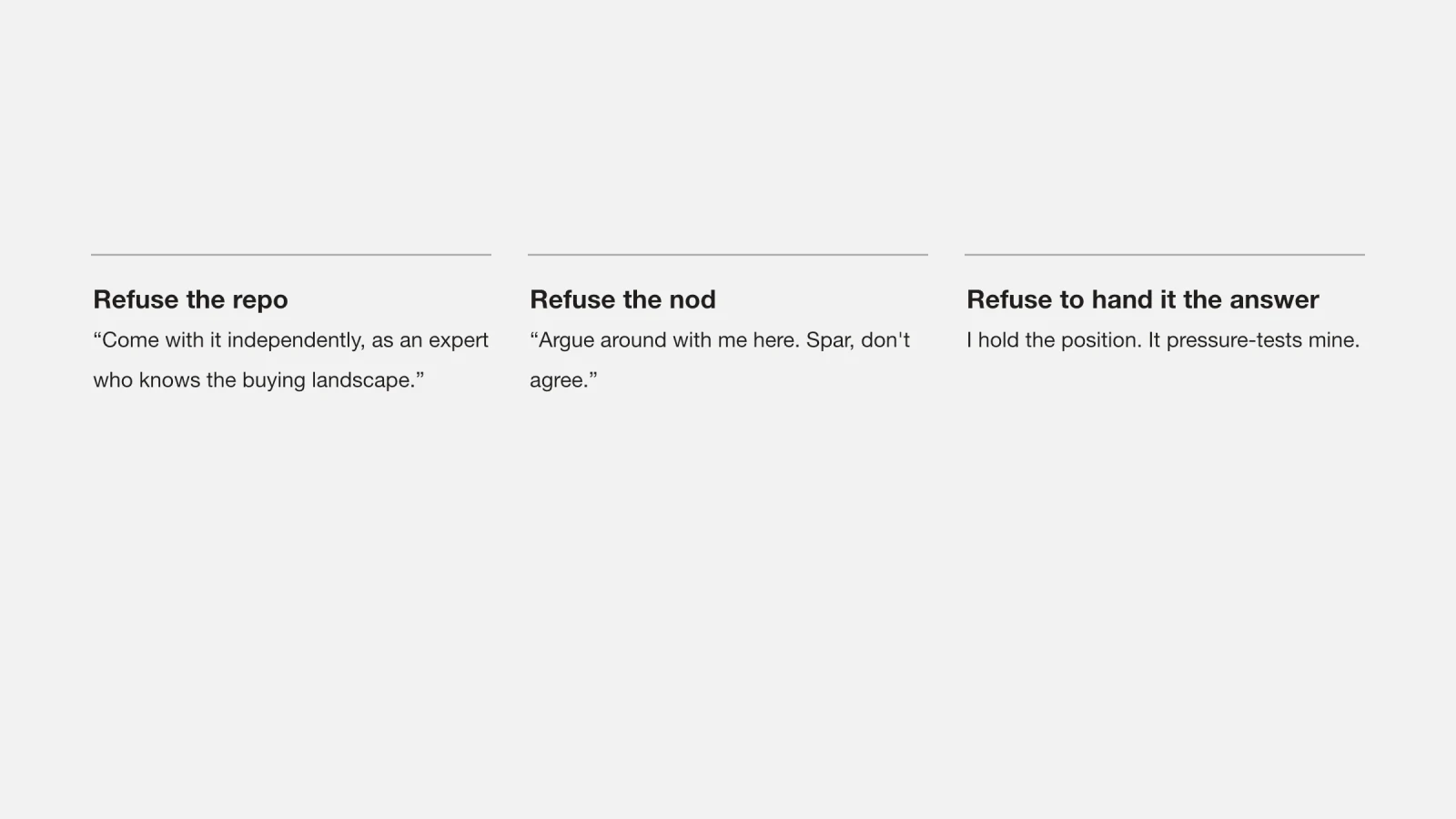
Three refusals preserve useful friction: delay repository context, postpone sidebar ideas, and make the agent argue instead of resolve.
Saving hard-won conclusions as self-contained notes turns separate agent sessions into compounding knowledge.
Summary
The talk treats an agent workspace as external working memory. A user can leave an idea, ask the workspace to catch up on an earlier thread, and resume close to the point where the thought stopped.
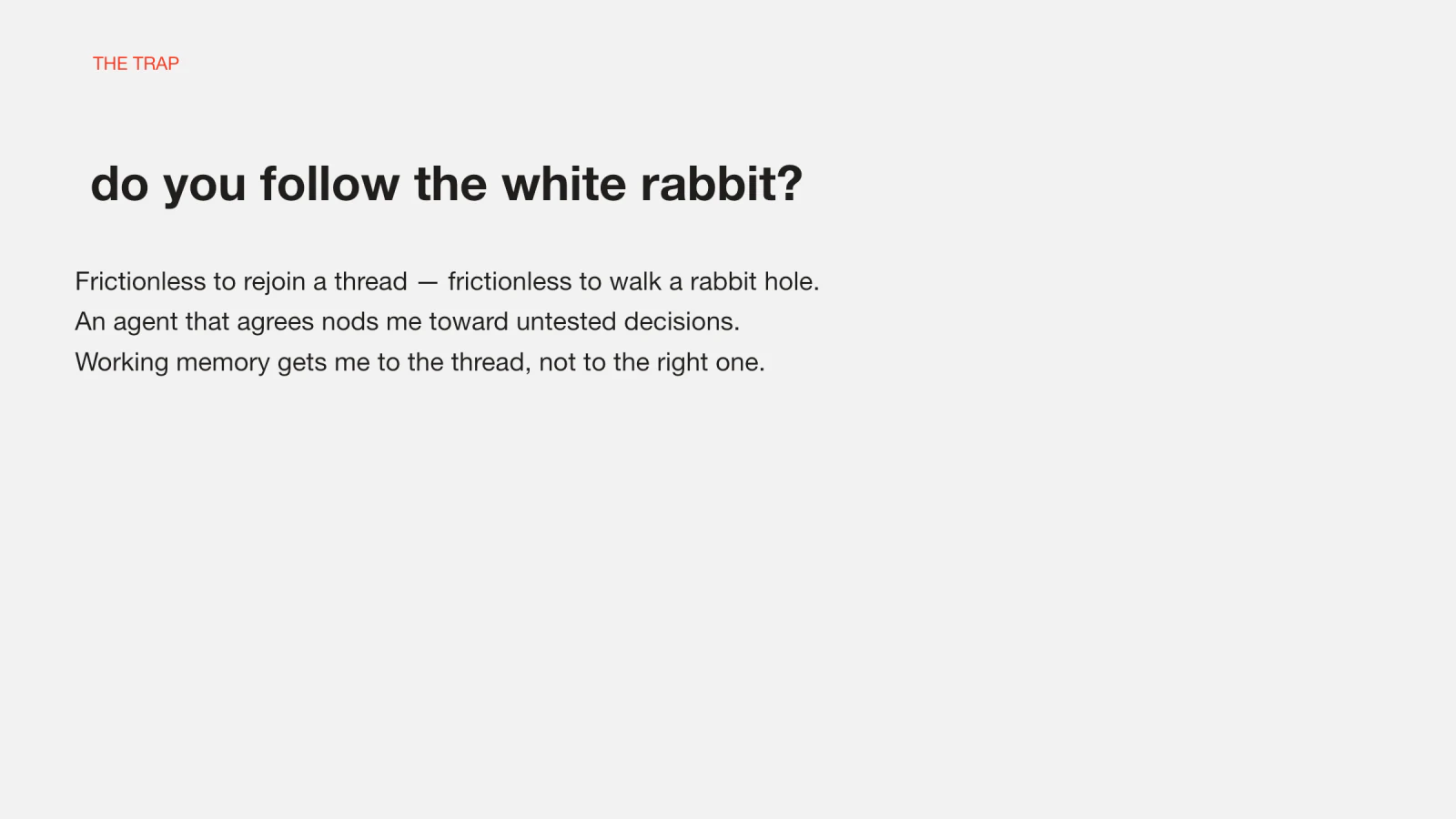
That convenience introduces a failure mode: frictionless re-entry also makes it easy to follow an attractive but irrelevant rabbit hole. The proposed safeguard is not more memory alone, but a workspace that pushes back through three deliberate refusals.
Refusing the repository asks the agent to form an independent view before seeing the existing product. Refusing a sidebar protects the current context. Refusing to hand over the answer keeps the user's position active, while selected conclusions are saved as self-contained notes that can be evaluated later.
The speaker described Enzyme as a briefing layer that agents can install to explore a workspace. The method and product status are grounded in the presenter's personal workflow and consulting experience, not a comparative productivity study.
How it works
01
Resume the earlier thread
The agent reads selected turns from a prior conversation and continues from where the thought stopped.
02
Control incoming context
Ask the agent to form an independent view before revealing the repository, and park unrelated sidebar ideas outside the active thread.
03
Make the agent argue
Use the agent to pressure-test the current position instead of resolving the question immediately.
04
Save a self-contained position
Write the chosen conclusion into a standalone note that future agents or reviewers can evaluate against later decisions.
Slides
Transcript
If you haven't met, I'm Josh. This talk's is gonna to be about, designing workspace around your working memory, so that you can re-enter your thinking, the moment the inspiration strikes, and then make it argue with you instead of flattering you.
This, inspiration is from this kind of came from something I think about a lot, which is the idea that the best playlist usually comes to you when not when you sit down to make one.
Then I think it's the same thing with product thinking, because, like, with product thinking, it usually shows up five minutes before you go to bed, not while you're in stand-up.
And, the reason I think about a this a lot is I worked on, playlist products a lot at Spotify for years, thinking about music curation habits. And, I think there's a lot of parallels to product thinking. When I think about how I curate playlists, I'll mostly be consuming things in the background, and every so often I'll be adding a song to a playlist if I remember it, or I'll be saving a song to my liked songs if I remember it, but it's very sporadic. And so curation is very sporadic. Thinking is also very sporadic. What if you actually turned, your workflow around that fact instead of against it?
And I think this shows up in actually my own personal workflow. A year ago, if I had an idea before bed, I might add it to a to-do, to-do list, and, today I actually send a prompt, from bed. And I think what changed is that the workspace holds my working memory. I ask it, in this example here, I asked it to catch up on a thread, a different agent thread, and review it the last fifteen turns. And then it would turn exactly where I left it off. I was exploring a thread on, TikTok and UGC because I really suck at GTM. And, just thinking through it, I just had this idea pop into my mind.
And this is what it's like for my workspace to hold my working memory. Inspiration stops, becomes something I put down and becomes something I can actually act on.
But that's dangerous because, as frictionlessly as you can re-enter into a thought process or, like, acting on something, it's also really frictionless to rabbit hole on that idea. And I might end up, like, stress testing something that I never really thought about. Working memory actually helps me get back to the right thread. And, for that to work well, I need it to argue.
So I'm gonna to talk about, like, three kinds of refusals that I typically practice, when I have this, frictionless re-entry into my working memory. 'Cause otherwise you can, kind of get in these, like, spaces where it doesn't actually help you be more productive. First one is, refusing the repository. I'll go through a specific example of that. Second is refusal of a nod to, like, maybe explore something that might have mattered to you but you don't want to think about right, right now. Third is, refusing to give it to the answer. And so this is, like, actually a conversation I had, with an agent, like, a few days ago. It was prompting me to it was actually suggesting that to go and explore the repository to check to see if a new product idea I had would iterate, would actually take the product to the next level.
And I told it no. I told it, "Stop investigating the repository." I'm actually more interested in seeing, what it would come up with independently, in order to serve as an expert later on. Buying landscape was something I was exploring, and I'm like, "Well, I don't need you to, pander on where my product already is. I want you to go and figure out what is objectively out there before I give you my approach towards it."
Second is a refusal of a nod. So, it was offering, "Oh," like, "Should we go and explore this sidebar thought right now?" I said, "No, don't explore that sidebar. This is nice to have for later, but we don't want to clutter the context of a thread right now. Argue with me about this here."
Third, here's, here's a thought where, like, I, actually went into something that, you know, it, highlighted something that I hasn't hadn't really figured out yet, and I wanted to capture it into a note. And so just to read it since the text is a little small, "That's good. The cold start seeding is more of a later step, and we don't need to flesh that out the whole UX right now, but it's the right place to end on. So all that we've been arguing about is worth putting into a note. There might be simple arcs that you need to capture in order to describe the landscape fully. So make it self-contained enough so that this doc could serve as an expert that a reviewer of this product could read and evaluate against."
So I told it, like, "Go and actually write that all to a markdown file that I can refer to later." Not right now. I don't want it to go and, revamp my product right now. I'm, like, saving it into a document very intentionally so that my agent can kind of, like, compare the two later on.
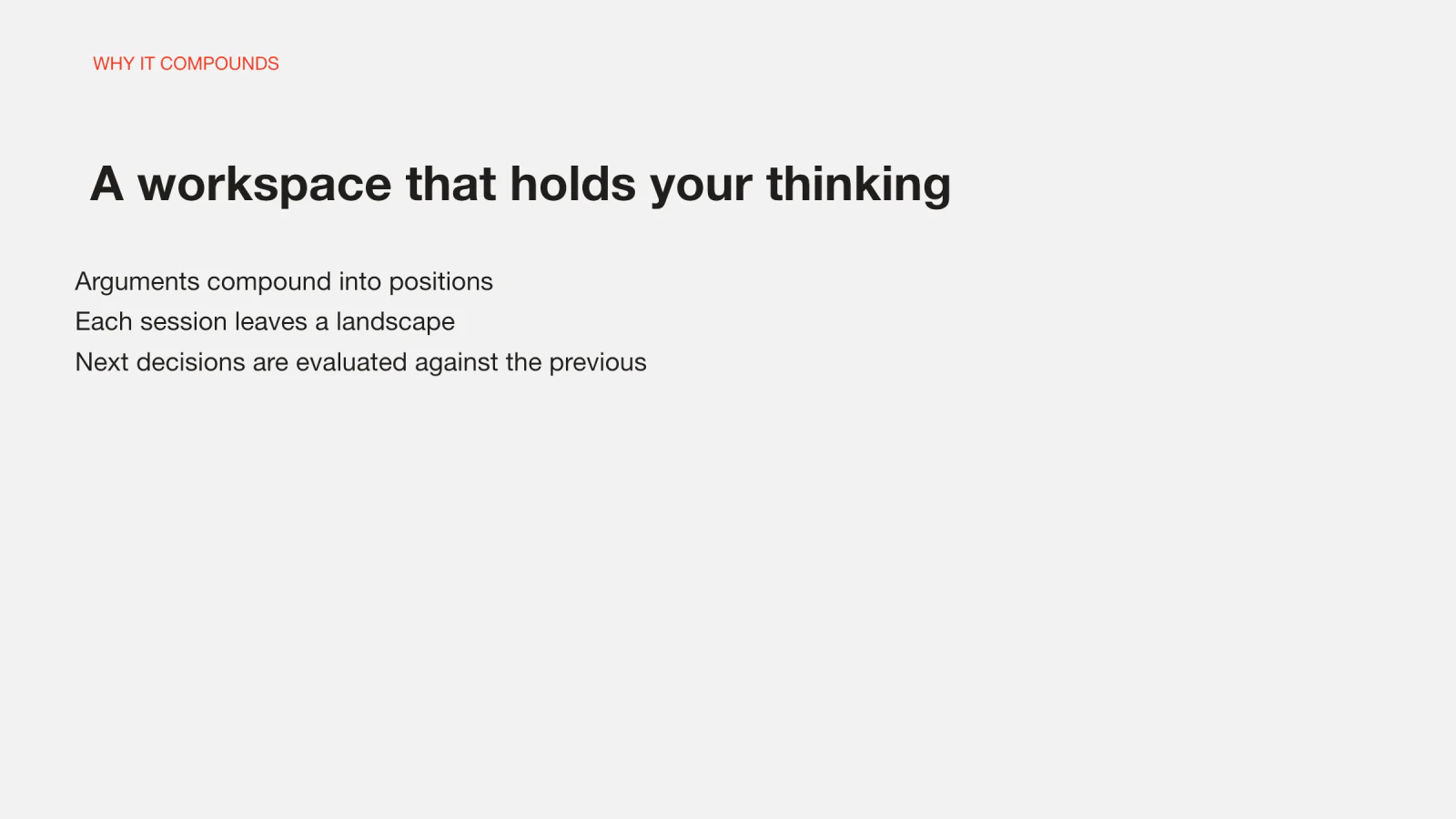
And I think, like, this highlights an interesting idea, which is that, you'll notice, like, a high degree of agency over what gets stored to memory. I actively control what it writes down, and I give so I can give it context on how later. And you do that enough times, and the arguments accumulate into a kind of a real position, a landscape that you can kind of evaluate against later, sharpened by the conflict. And, this is what I call compounding knowledge.
So, I think a lot about compounding knowledge, your agent workspace is something that you design. I, help, I help founders think about designing it to think. I build a, briefing layer for your agents to know your workspace. It's called Enzyme. If you scan the QR code, it'll take you directly to there. You can have your agent install and explore it.
Do you think that the kind of patterns or, yeah, flows that you're seeing work now are something that are lasting and will continue to be a differentiator, or it's just sort of a correction for the current status of things which will look extremely different in six to twelve months' time?
I think, and when I talk about, like, acting on a spark of inspiration, I think there's an assumption that, like, time away from a computer, time away from an agent is, like, gonna help you think more clearly. But kind of what's scarce is your ability to act on these things. And but I think that what an agent needs to act on is a rare insight that you might not always have. So maybe what's temporary, what's fleeting is, like, your own inspiration. That may not bake into the bigger picture of what you're currently building, but if you leave the breadcrumbs for your agent to work with and improve your product later, it, might connect the dots in a way that might not, might not have happened systematically.
When you, help founders design or, "I help founders design it to think," is that design, is it different, like, founder to founder? Is there a lot of, variation or is there a lot of just common patterns? And then maybe what are those, like, differences from founder to founder?
I think, I mean, I just enjoy working with, like, how founders organize their agent workspaces, and I, learn a lot, and I think there's a little bit of mutual learning here. I, think I've, The reason why I, say help is, I, have a, I've, like, built up a personal knowledge base over, like, three to five years, having been working with agent workspaces within that workspace for about two of those. And so there's ways, ways in which these knowledge compounds, in ways that, like, the failure mode of, the failure mode I'm seeing a lot now is that founder will come up with idea an, idea on how to organize their workspace over a weekend. But then three or six months down the line, when they go to try to figure out, pick up where that, they where they lost the thread, it's hidden in some leaf node of, like, nested links somewhere where the agent doesn't know how to look for.
And, I'm seeing a lot of this happen. And I think there are design patterns around how knowledge actually compounds so that, your agent doesn't lose what essentially was kind of like a circle back to, like, an idea that you've already had.