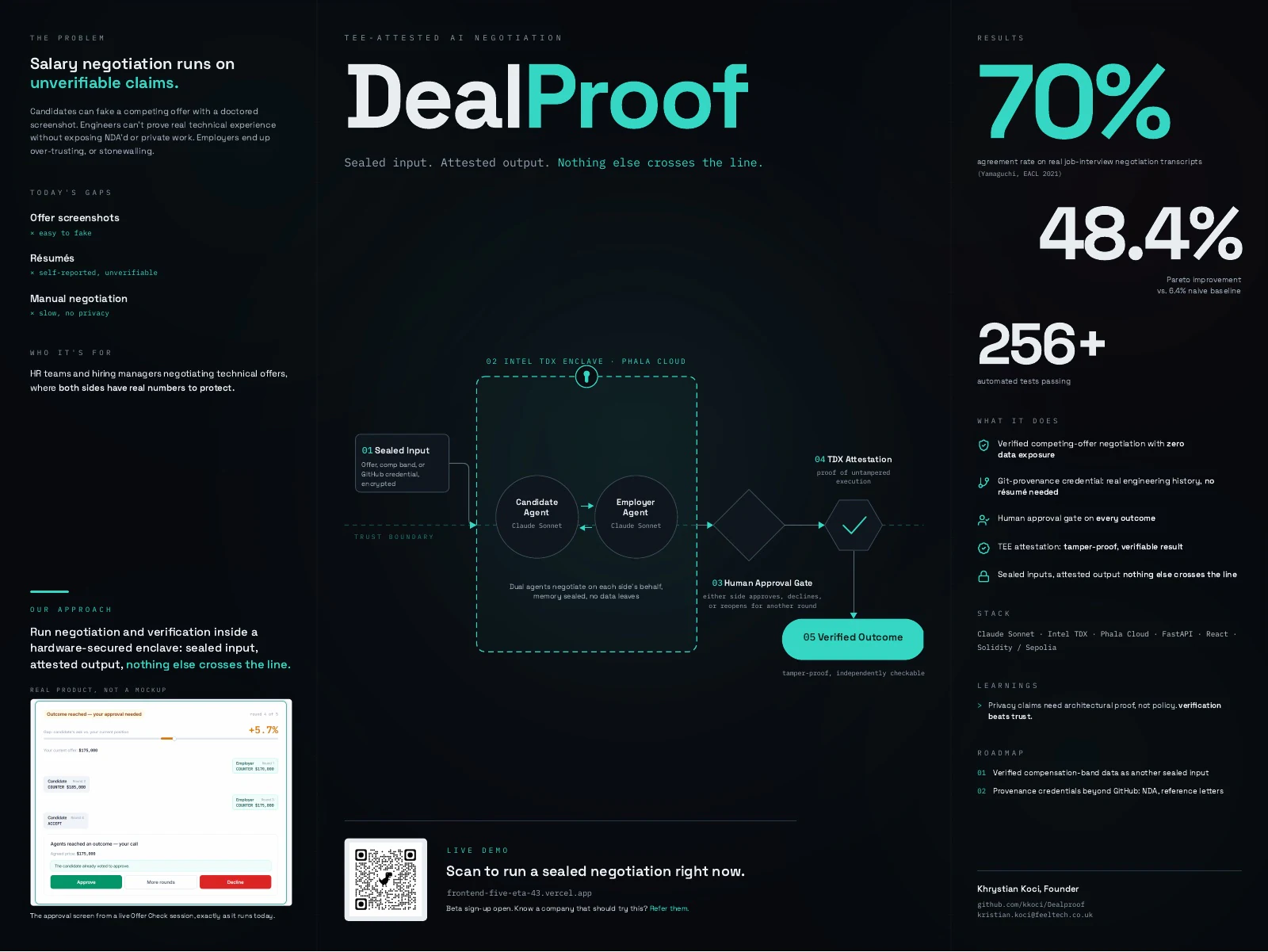
Salary negotiations need verifiable evidence without forcing either side to expose sensitive data.
DealProof
Negotiate data deals between agents over sealed evidence inside an TEE, with human approval before the result is finalized.
Key takeaways
Two agents can negotiate over sealed inputs inside a TDX enclave without seeing either party’s raw data.
Cryptographic negotiation does not replace consent: both parties still accept, reject, or continue each round.
Summary
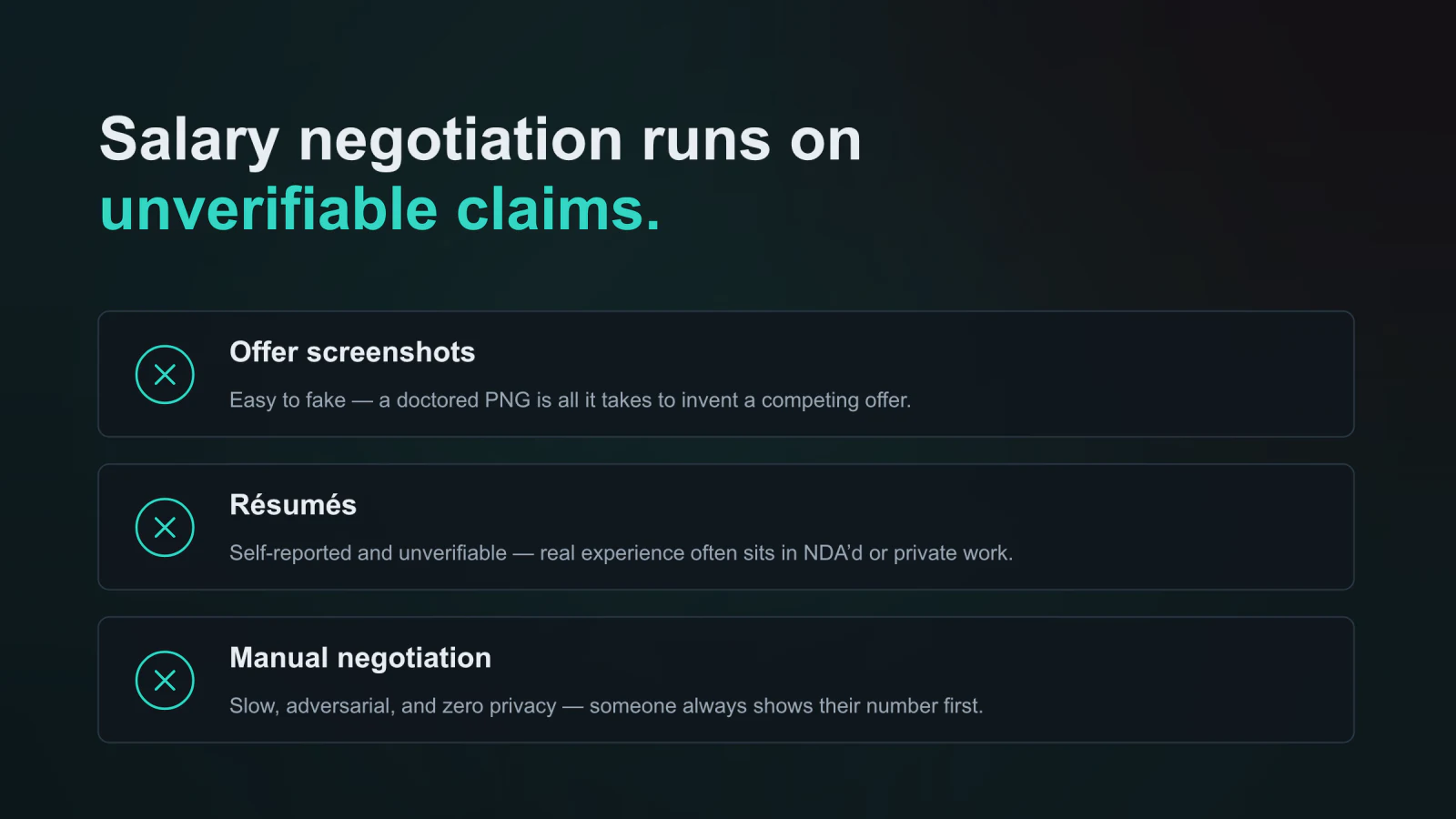
Salary negotiation often depends on evidence that is difficult to verify safely. The presenter points to competing-offer screenshots, private repositories, nondisclosure agreements, and other work history that a candidate may be unable or unwilling to disclose.
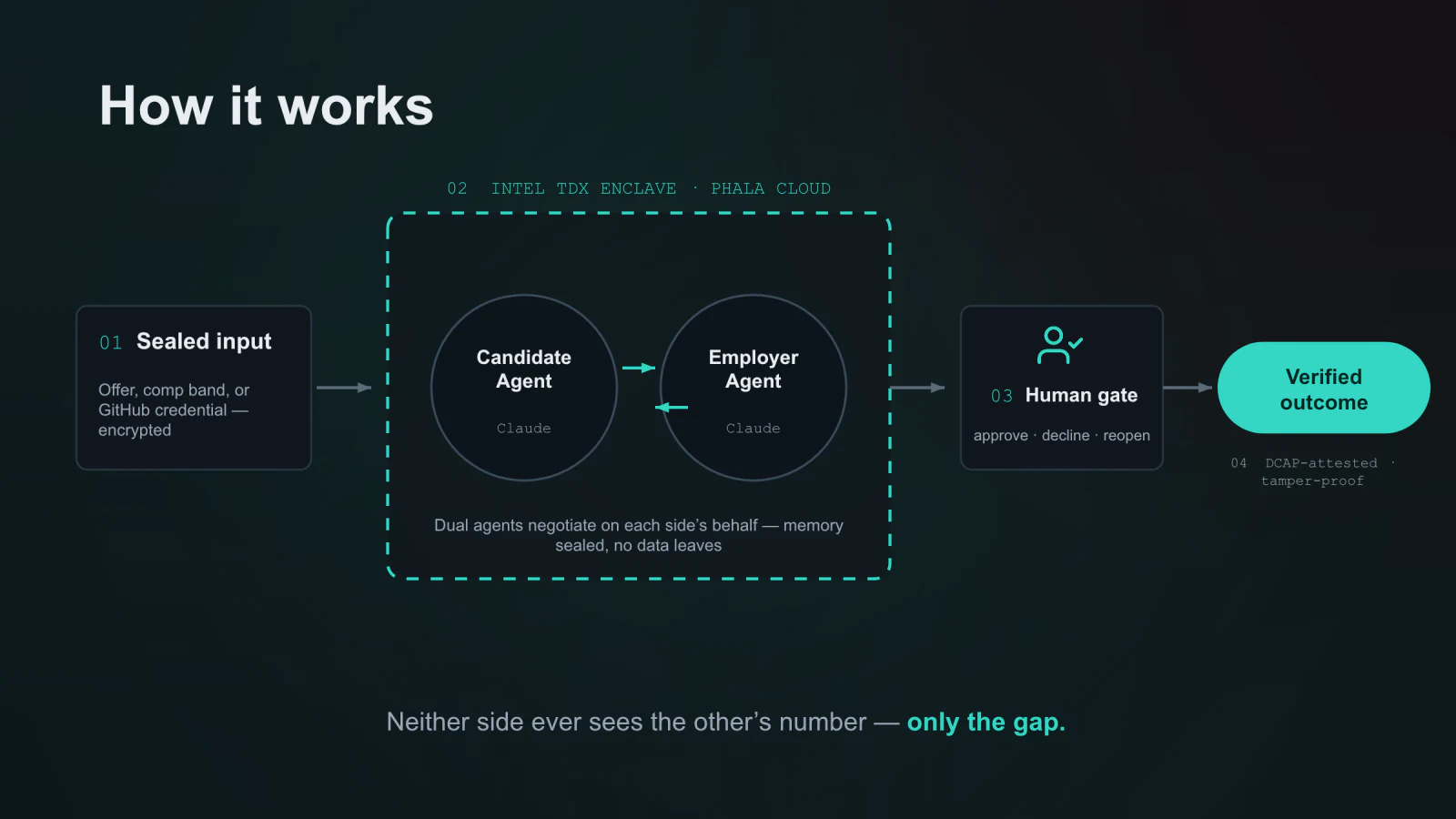
DealProof is presented as a two-agent protocol: one agent represents the candidate and one represents the employer. Both run inside a TDX enclave over sealed inputs, and the stated design prevents either party from seeing the other's underlying data.
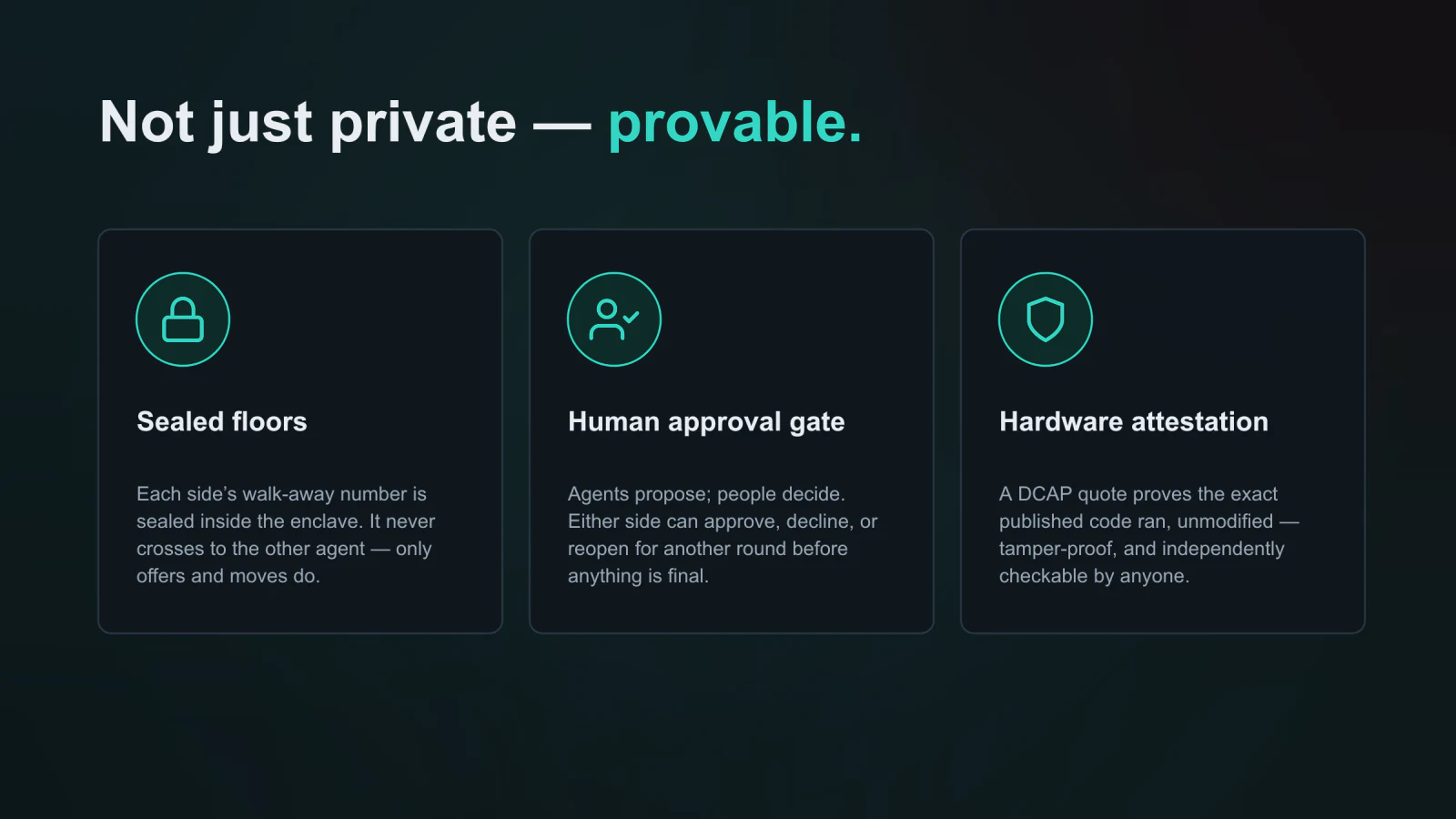
The agents do not make the final decision. Each negotiated outcome passes through a human approval gate, where either party can accept, decline, or request another round, after which the execution is described as signed and independently verifiable.
The presenter reported benchmark results, automated tests, and a live Phala deployment, but those figures and deployment claims were not independently verified for this publication. The stated roadmap extends provenance beyond GitHub activity to evidence such as recommendation letters, email exchanges, and agreements.
How it works
01
Submit sealed evidence
Candidate and employer inputs are sealed before negotiation so neither party can inspect the other's raw evidence.
02
Let two agents negotiate in the enclave
One agent for each party evaluates the sealed inputs inside a TDX hardware enclave.
03
Put the outcome behind a human gate
Each party can accept, decline, or request another round before the result is finalized.
04
Sign and attest the result
The approved execution produces a cryptographically signed, independently verifiable outcome without exposing either party's raw inputs.
Slides
Transcript
I'm Christian, founder and developer of DealProof. Salary negotiations run on unverifiable claims. Candidates, might fake, competing offers with screenshots. For example, engineers might not be able to, give proof of their experience without exposing NDAs, private repositories, private work, or, employers might end up, overtrusting or stonewalling. DealProof, solves this by, offering, making the negotiation cryptographically provable, not just private, but also provable.
Two CLOB agents at this point are CLOB agents. It might be open source in the future, but right now it's two CLOB agents negotiate on behalf of each party, one for the candidate, one for the employer, entirely inside a TDX hardware enclave, sealed inputs, attested outputs. Neither party is able to see each other's raw data.
Every outcome, is, tied to a human approval gateway. Each party can either accept, decline, or ask for more rounds, and the whole execution, it's, cryptographically signed and, independently verifiable.
Also, this has been run, against real academic benchmarks, having seventy percent of acceptance rate with the agentic negotiation, forty-eight point four percent improvement over, an naive baseline, two hundred and, two hundred and fifty-six, automated tests passing. It is live, deployed on, CVM on Phala right now.
Has been called, the most complete, work implementation of this paper by Andrew Miller, one of the authors of the paper.
And yeah, so future plans, it's, about extending a provenance, not making it not just GitHub developer-centric, but more about, demonstrating NDAs, showing provenance of NDAs, recommendation letters, email exchanges. And, yeah, so anywhere two parties negotiate with sensitive data, that's the pattern where DealProof, fits.