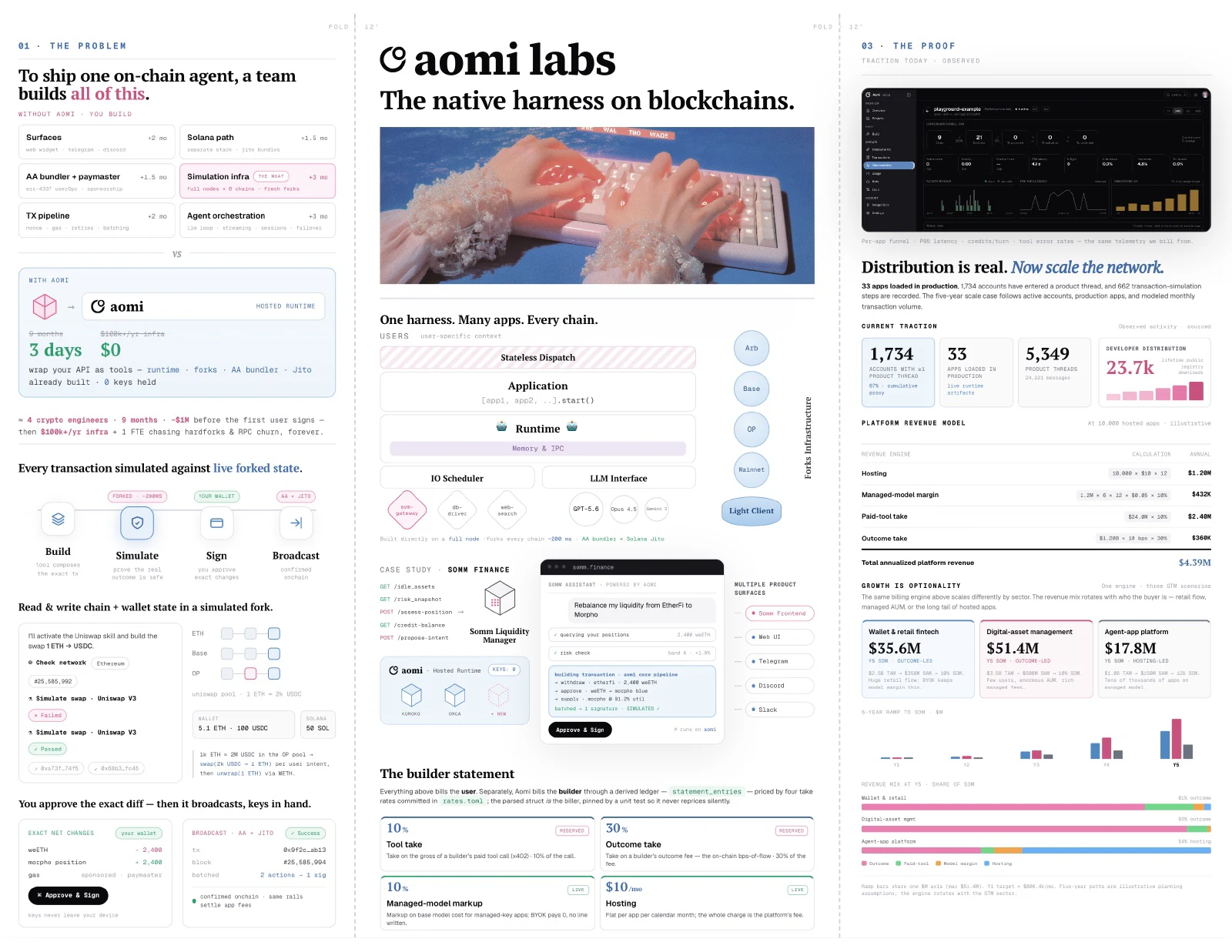
A reusable execution layer lets on-chain agents act across EVM and SVM chains without rebuilding every integration.
Aomi
Turns natural-language intent into policy-gated blockchain actions, with tools for simulating and signing across EVM and SVM chains.
Key takeaways
Every transaction is simulated against fresh forked chain state before wallet-specific signature policies permit execution.
Outcome-based pricing can tie fees to value created on-chain instead of only compute or API usage.
Summary
Aomi is framed as a reusable harness for on-chain agents rather than a single trading bot. The stated goal is to remove the specialist work required to combine chain-specific simulation, account abstraction, MEV-aware routing, interfaces, and agent orchestration.
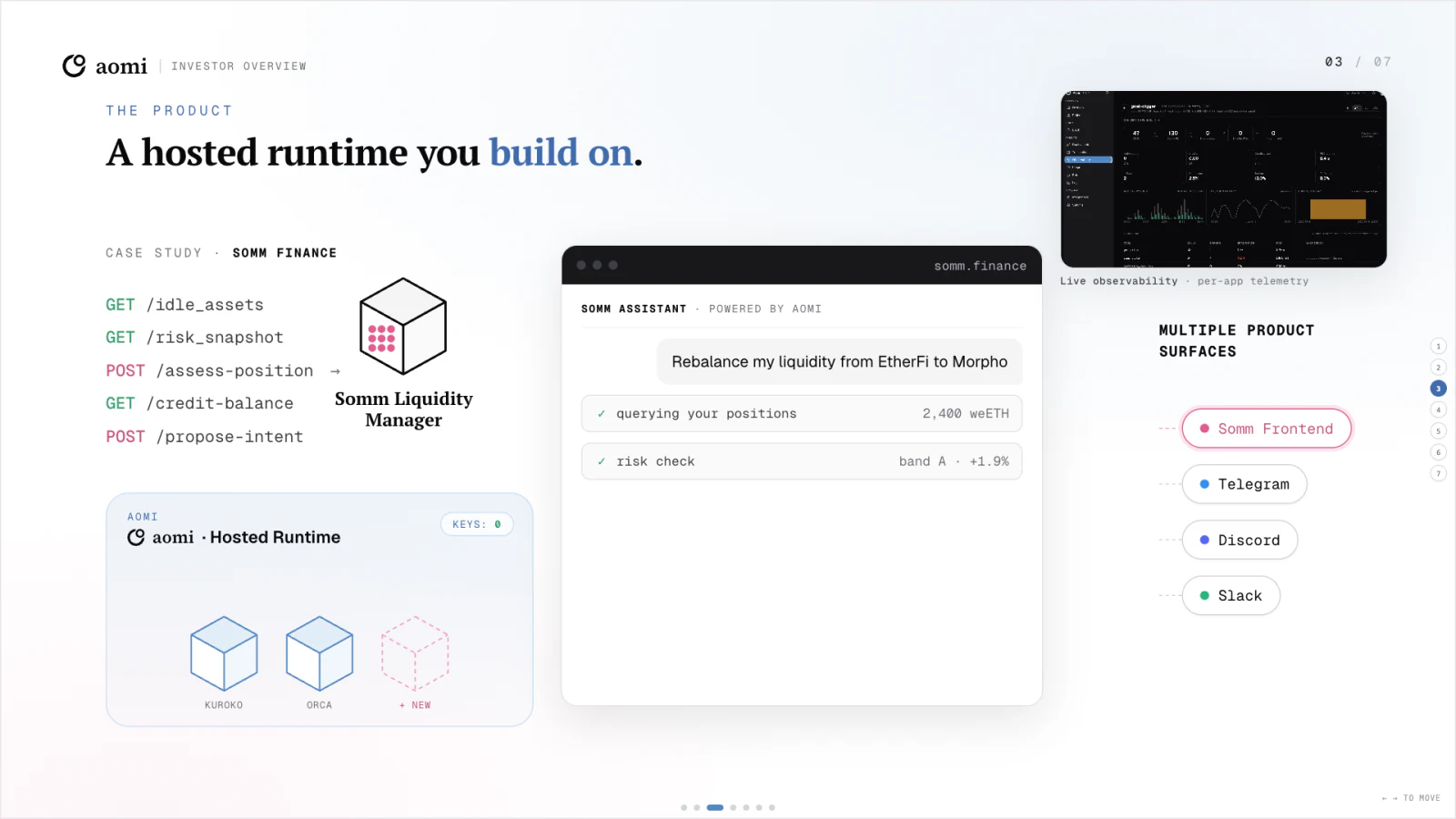
Customers can package their own APIs and tools as Rust plugins, which Aomi loads into its hosted runtime and executes through a shared pipeline. The talk describes web, Telegram, Discord, and dashboard surfaces for managing applications and assets.
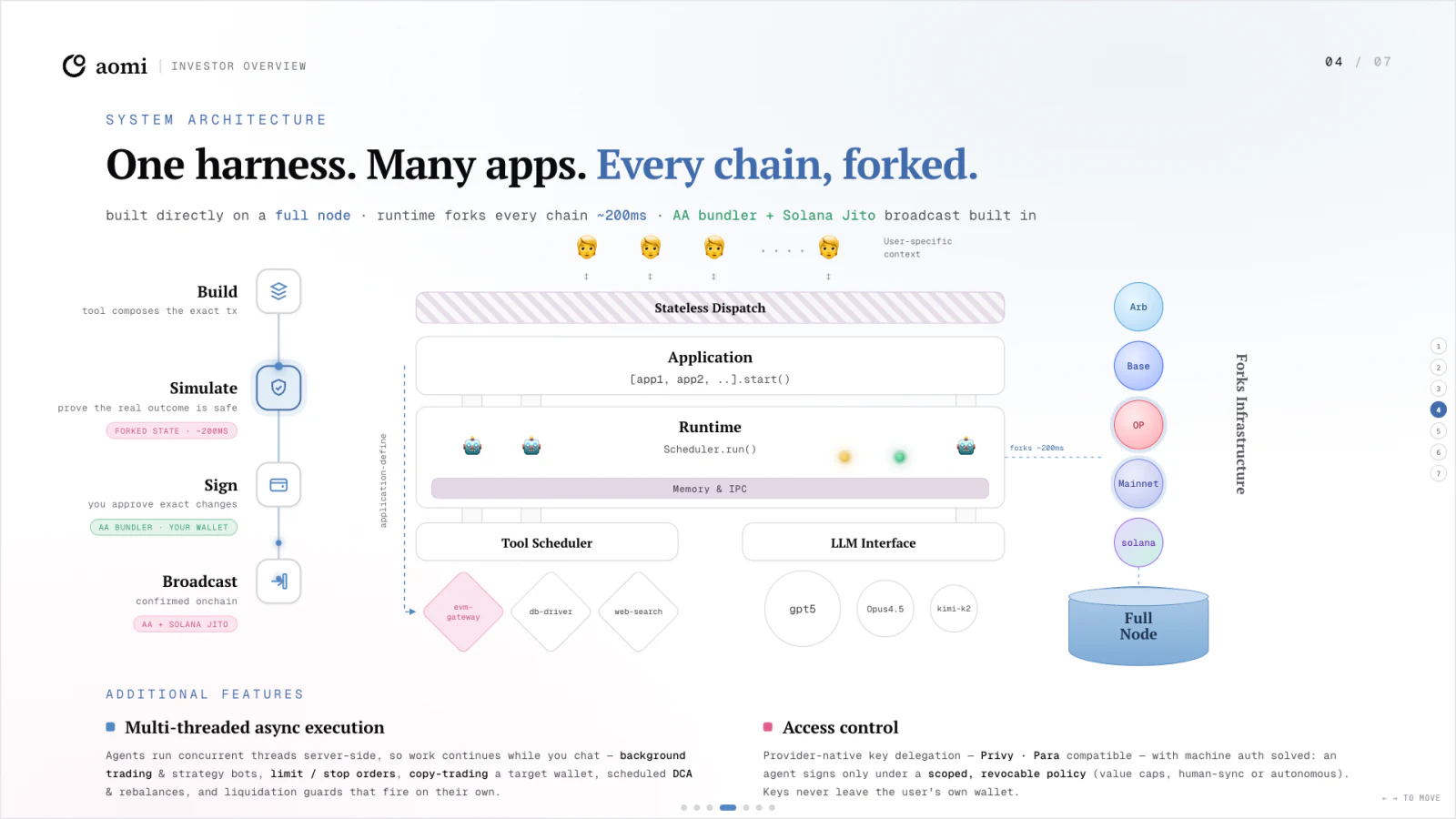
Natural-language intent enters a system backed by light clients that refresh forked chain state for simulation. Before state is applied to a chain, the transaction must pass simulation and the relevant signature policy; the speaker separately identifies multi-wallet access control as a difficult part of the design.
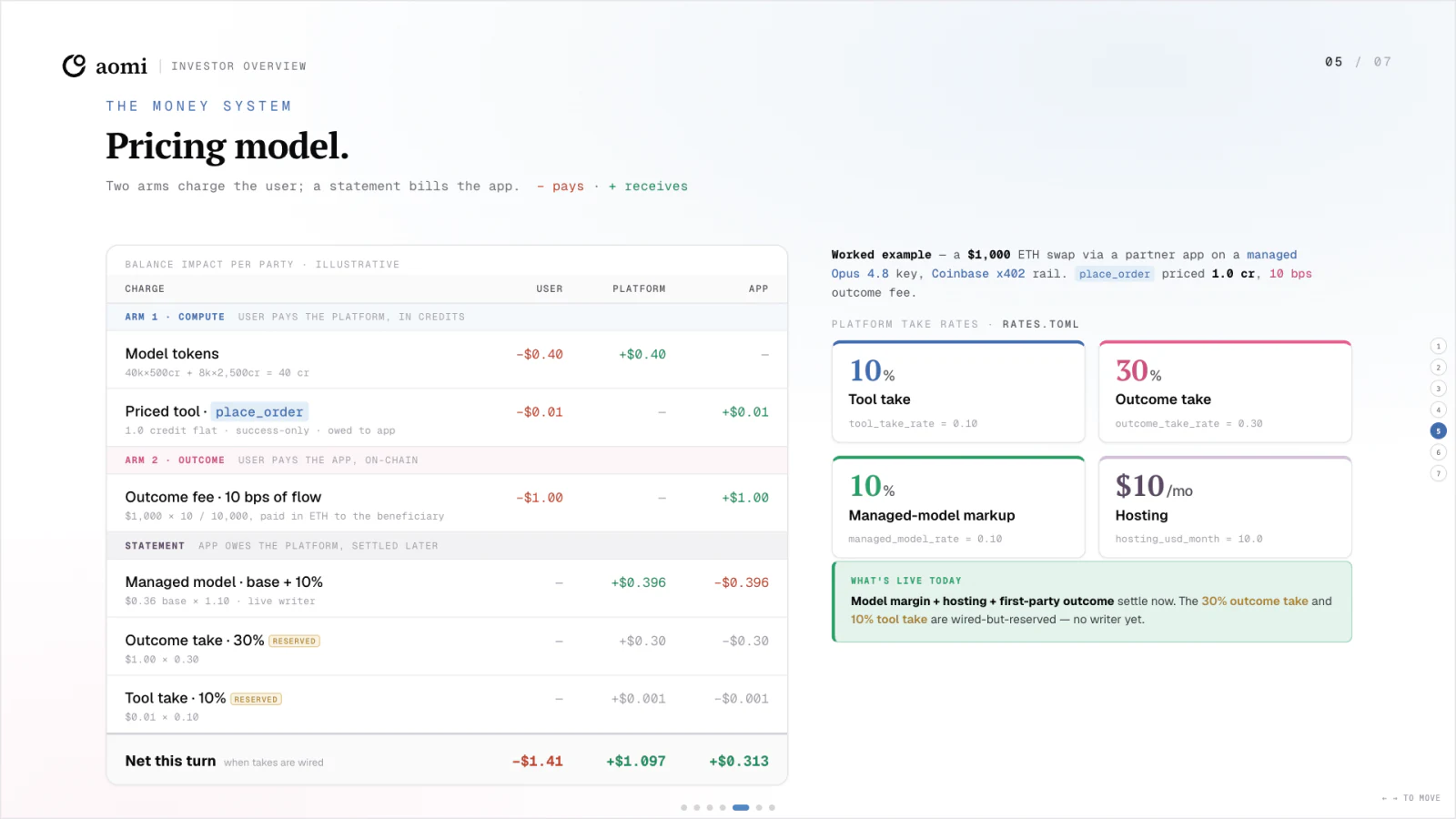
The proposed hosted business model combines per-instance hosting with tool-call fees and outcome-based pricing. In the outcome model, Aomi can inspect the post-execution chain state and charge a share of the value attributed to the facilitated transaction.
The speaker reported user and download figures and presented market projections, then explicitly cautioned that the projections were model-generated and might not be reliable.
How it works
01
Load application-specific tools
Customers package their APIs and tools as Rust plugins that the hosted runtime loads alongside its core execution pipeline.
02
Translate intent into a transaction
A user or application describes an on-chain action in natural language, and the execution pipeline turns it into a transaction across supported EVM and SVM chains.
03
Simulate against fresh chain state
A fleet of light clients refreshes forked chain state roughly every 200 milliseconds, and the proposed transaction is simulated before it can progress.
04
Enforce wallet policy and sign
Wallet- and account-specific permissions gate the final state change; only a transaction that passes simulation and policy checks proceeds to signing and broadcast.
Slides
Transcript
Hi everyone, my name is Cecilia, and I am building, Aomi Labs. We are a harness that is natively built with a node, natively built with, like, both EVM and, SVM infrastructure. That being said, we are basically functioning as Claw code on onchain, where Claw, is operating on your file system, and then you can do whatever you want with your operating system and your file system. And on us, you can basically say that, find me the highest yielding pool across all supported chains, and I wanna bridge and, stake my money in. So it's like generic and universal execution. And that being said, it's twenty twenty-six, and it's no longer impressive to have, like, a agent operating onchain.
So why does that matter? I guess the point I try to get to is, as we know, like, Fintech's converting to, crypto, right? And up till now, onchain finance is still a unsolved problem. There's no, like, a out-of-the-box super Supabase solution for Fintech company that, that's gonna operate onchain. Like, for example, you wanna automate your assets management or your assets, your vault, right? AI-driven vault management is, like, a big thing right now. And, for stuff like that, imagine if you wanna build the nitty-gritty details for, all of the architectural pieces. You have to build, like, surfaces. For example, Solana path. Just imagine if you wanna, simulate your transaction and make sure that they're secure and bundle that as, like, account abstracted bundle.
And on a Solana path, if you wanna hook yourself up with a Jito, a Jito, bundler and then just prevent MEV and all that. Just, like, figuring out the detail for building AI onchain, takes a lot of expertise, and it's probably gonna drain your resources and time if you're just, like, a financial company that wants to do your business, right? And this is where we come into play. We wanna to make it as easy as Vercel and as Supabase if you wanna to launch, agentic parts on the blockchain. And that being said, another part of the hosted cloud business of the company involve letting people, bundle their, build their custom plugin with the API and, tools that they wanna to use as a Rust program.
So we, load the executable onto our runtime, and we still do the execution, with our core pipeline, which, actually do, like, the, execution that, for example, rebalancing liquidity between Ether.fi and Morpho, where we have, asset management companies actually building their own plugin, and we load, and we host that, right? And then we also provide SDK on, like, web UI and, Telegram, Discord, just like how OpenClaw work. Yeah, and then we have, like, a Vercel, like, dashboard interface for people to manage their enterprise assets and the bots.
So this is the architecture as a whole. I think it's very intuitive. Basically, it goes from, like, natural language to, a fleet of light client that keep forking each, each state of the chain every two hundred milliseconds and perform the simulation and make sure that the transactions are actually legit. And, we, are compatible with, like, Solana as well. So, the Jito bundle works in the same way, because, like, every chains are basically, the same, the same abstraction, right? And, on a side note, we also support, like, multithreading multi-threading and asynchronous execution, just like the other AI harnesses, because we do wanna to enable people trading twenty-four seven, and we wanna to enable, core and job.
Like, I wanna to place a trade, or, like, I wanna to do certain agent execution when you're not present. And that being said, actually access control become a hazard because, because the, authentication ecosystem on blockchain is actually very complicated. You have people using browser wallet, and you have embedded wallet, right? And you wanna resolve that under one account, and actually have a multi-threaded agentic operating system operating on multiple wallet at the same time. And different wallet has different access control, right? So it's a system where, natural language goes in and transaction goes out, and then we gate the final output, be like, okay, first of all, it has to be simulated, and then the signature has its own policy.
We implemented, like, a full suite of, like, Linux-like system where, you know, we gate the final output of the, when state is being applied back to the chain. So yeah, state has to be simulated, and it has to be correct, and, then it shall be signed, right? Yeah. So this is the core architecture. And with the hosted model, our pricing is actually very straightforward, right? We host runtime, and we host executables and agentic application for bots, for trading bots, assets manager, and or just developers, right? And we charge ten dollars per each instance that we host. And the other, cost just basically goes to zero. The best scenario that I've seen is with, like, a GameFi project who used to run, like, OpenClaw instances for each user who's burning, like, twenty K per month.
And after they Come to us, like the cost immediately went down to zero, right? And we also charge like 10% for like tool costs if people want us to like expo to gate their API calls, we'll take some cut out of that. And then we also... Oh, and a very special thing that we can do compared to like, that are different, that differentiate us from Vercel or Supabase is we can do outcome-based pricing based on the final state of the chain post-execution. So let's say you're an assets manager and then your outcome is actually moving money from pool A to pool B, right? And then we can see basically like the end state of the chain and be like, if they take 100 bips, will take 30 bips out of the 100 bips.
So we basically impose a sales tax for the transaction that we help facilitate. 'Cause my philosophy is AI is there to, automate transaction and to facilitate better, faster, and easier financial rails. And I think, outcome-based pricing model is just very, intuitive for any AI hardest company.
Right. And in terms of attraction... We are now at like 1,000-ish of users, and then our download volume is like 23K. And in terms of like go-to-market, trivially we can be just be a bot launching platform, which we take a lot of money from just like hosting fee, like $10 each. But, the best case is if we work with like wallet and, retail fintech, like IRL, not on crypto, because the world is gonna move more and more on-chain, right? Like if, imagine a neobank that actually need like AI bot, you know, support or AI front end support to improve their UX.
I think we're a very good use case. And the best case scenarios is if we do like digital assets management, if we become like Supabase or Vercel, or WorkOS for, AI-driven digital assets management, then we'll be able to take a lot of, fee from the service that we are, we're providing. But yeah, that being said, like all these projections are from Fable. Maybe it's being it's being psychofantic. So like I'm not sure if it's real, but we're trying to get there. So if any of you need this type of services, the SaaS business that assists your AI to work on on-chain, let me know.
So why was it actually hard to have good on-chain execution? Because I was really shocked by how fast and good it was when I first encountered your project. And in fact, a bunch of Ethereum core devs who was doing, I think, auto client building, were surprised how fast it was. So, yes, any tricks?
So basically, a lot of multi-threading, a lot of resource allocation, like running many instances of light clients of different chains on, the same machine while controlling the memory, the bandwidth, and then just time the resource very well, prevent, you know, you know, locking, data locking. And also just like a lot of algorithms and, data structures, I guess. Just basic computer science Just like grind the shit out. That's the most important. It's like not rocket science at all.