Portfolios can be hedged against underlying events, not only price movements.
Daedalus Anchor
Maps portfolio risks to tradable event contracts, then explores custom underwriting where public markets cannot provide enough coverage.
Key takeaways
Grounding agents in live market catalogs keeps proposed event hedges tied to contracts that can actually trade.
Thin public markets push larger and unlisted risks toward bespoke underwriting and RFQs.
Summary
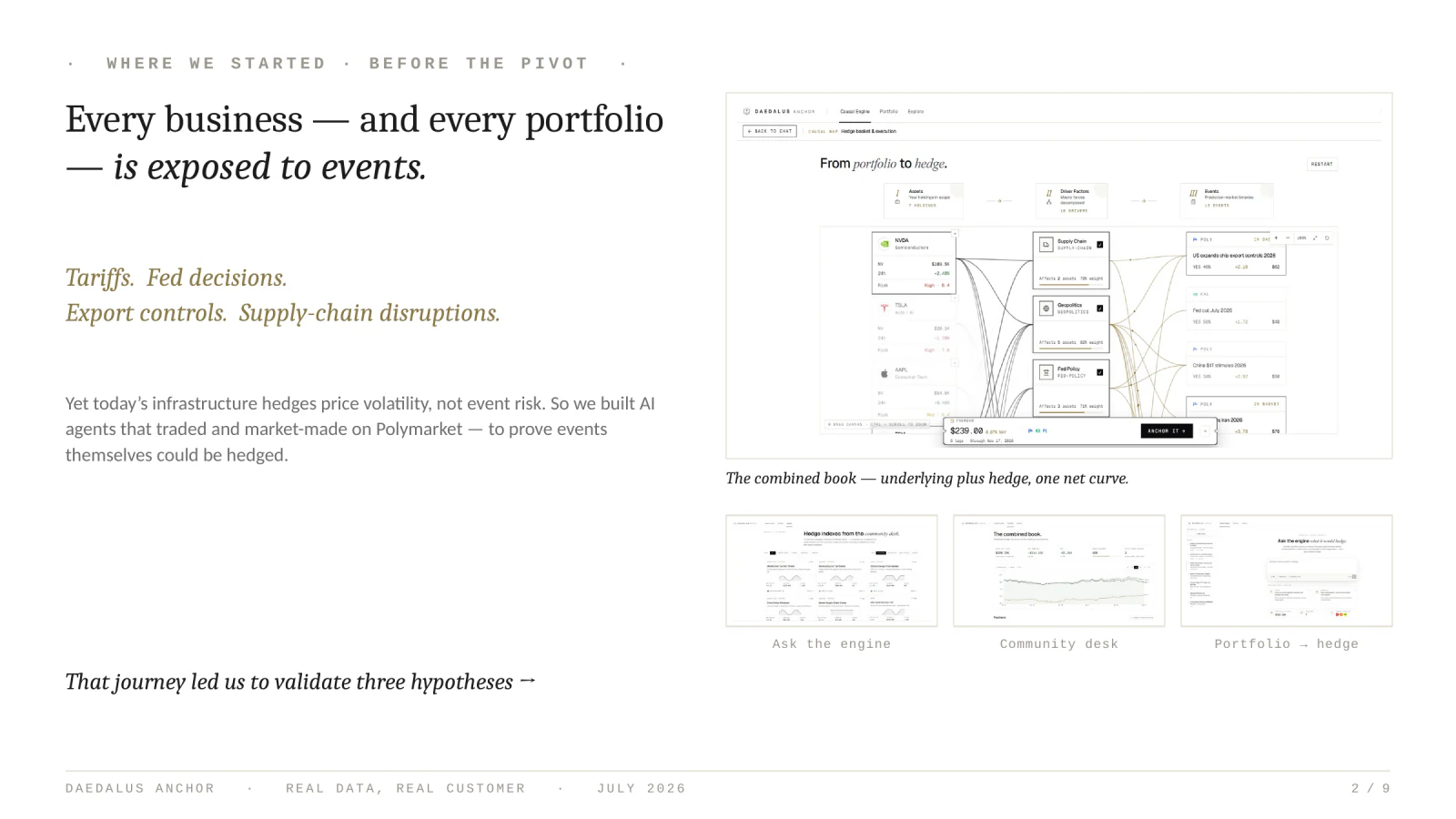
The project started from the observation that businesses and portfolios are exposed to events while financial hedging is usually organized around price volatility. Its first prototype used an agent orchestration layer to inspect a brokerage portfolio, identify underlying event risks, find related event contracts, and assist execution.
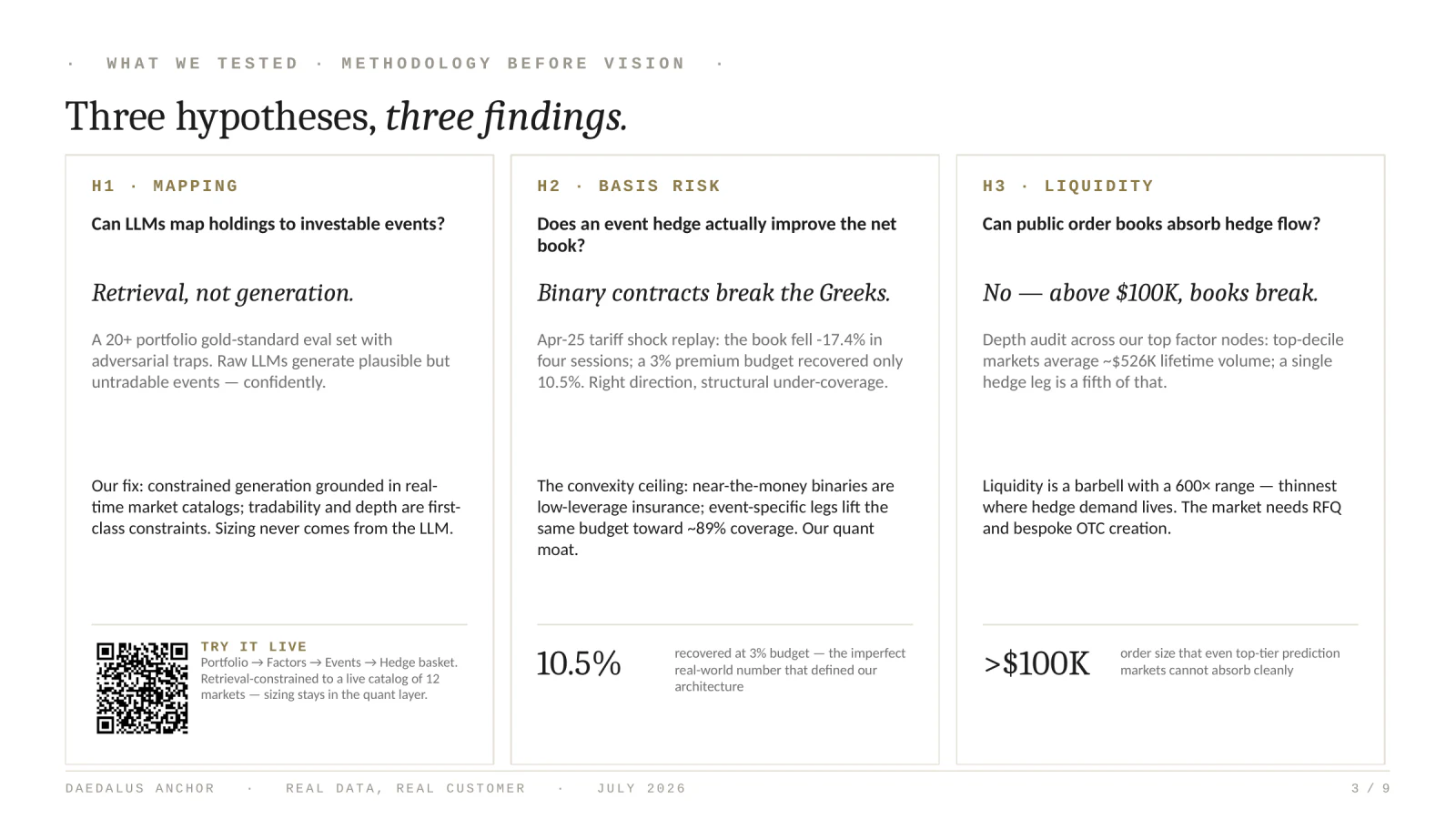
Testing produced stricter design constraints. The speaker said holdings could be mapped to events only when the task was treated as retrieval from a live catalog, and described the observed hedging benefit as partial because binary contracts limited coverage.
The largest break came from liquidity. The team reported that public prediction-market capacity ran out above roughly one hundred thousand dollars, which motivated a move toward an over-the-counter desk, a more sophisticated brokerage layer, and bespoke underwriting.
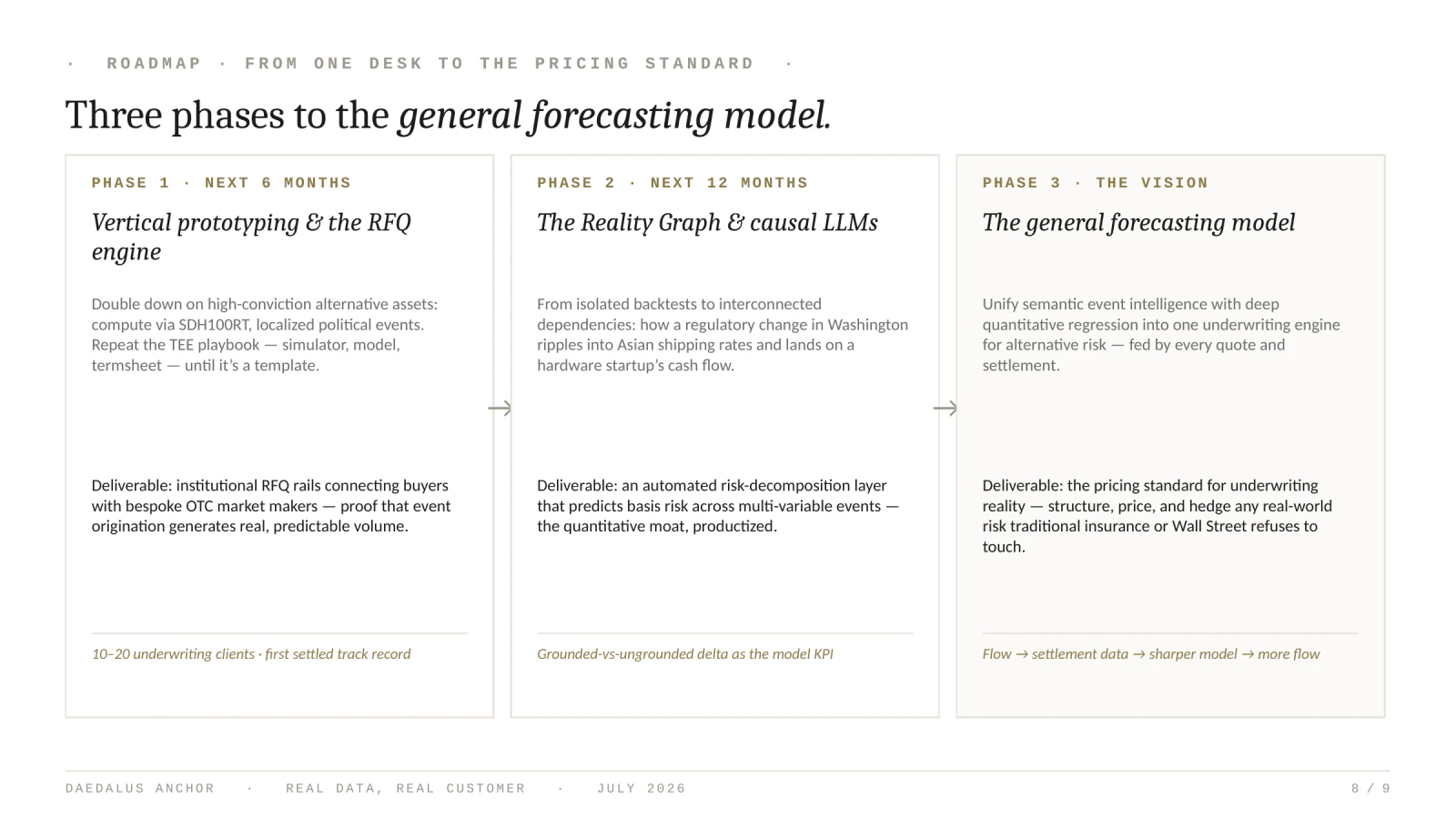
The broader thesis is that many real-world risks are neither standardized nor listed. The roadmap begins with compute markets and a request-for-quote system, then proposes a reality graph that models how events propagate through the economy, and ultimately aims at a general forecasting model for underwriting.
How it works
01
Map portfolio exposure to events
Agents inspect the portfolio and translate holdings into concrete event risks that may affect the portfolio.
02
Match risks to tradable contracts
The system retrieves only event contracts that exist in the live market, treating tradability as a hard constraint rather than inventing hypothetical hedges.
03
Backtest coverage and check liquidity
Historical replays estimate how much of a past loss the hedge would cover, while live-market checks test whether the intended order fits available liquidity.
04
Use custom underwriting for uncovered risks
When public markets lack a suitable contract or enough liquidity, the remaining risk moves to over-the-counter brokerage, requests for quote, and custom contract terms.
Slides
Transcript
Yeah, hi, my name is Ria. I'm from Daedalus Research, and we are building Daedalus Anchor, which is the general forecasting model for underwriting reality.
So we started with a really simple idea. So we think every business or, like, every investment portfolio are exposed to events. But right now, the financial markets are attribute to hedge against, the price volatility rather than events. And, a, few months back, we figured actually, prediction markets are a really good use case to solve this kind of problem. So we started with a simple idea to build a hedging system for stock traders, and we built a agent orchestration layer to analyze your entire portfolio inside your brokerage account and then spot the underlying risk and also identify the events contract you can trade against to. And, also we can help you execute.
But after this demo, there's a bunch of hypotheses we need to validate. And the first one is, can, agents actually be able to, map holdings to, tradable events? The answer is yes, but only if it's a retrieval problem. So, tradability should be a hard constraint, and we need to ground the agent system inside the, live market catalogs. And the second hypothesis is, does the event hedging actually work? So actually, the, answer is, yes, but partially, and there's still like this. And we run through We replace the 2025 April tariff shock, and it shows that a 3%, hedging budget can actually cover two thirds, average of the total loss. And, if we, if we improve the system, the ceiling is actually around, 89%.
And, the limitations are actually because of binary contracts. And the third hypothesis is, can public markets, do hedge at scale? The answer is actually no. So anything above 100K, the liquidity just runs out. So, which informs us to build a, OTC desk and also a more sophisticated, brokerage system. And actually, so through all our experiments, we figured the prediction markets are not really a really good, risk engine or, like, risk products. They actually ignored and avoided a lot of specific, problems, need to solve, for example, about, pricing the risk and underwriting them. So we stopped asking, so what prediction markets can use for? We started to asking, what kind what kind of, event risks already exist but nobody can actually hedge against?
And we don't really need to look far, because we've, we found out that right now, a lot of AI companies are already, looking at prediction markets to optimize their costs. And we started working with a AI founder who's running confidential computing, and his GPU cost, GPU rental costs actually surged around for-49% within the last year. And, which basically means, like, he right now has no future markets to hedge against that. There's a couple of reasons behind that. And, we started to build him a complete underwriting solution with, interactive simulator and also historical back backtest. And we also offered a custom contract term. The performance is roughly 80%, 80%, hedging budget can, cover the loss from 21, point five to point six.
But the compute market is just one example. And, there's a lot of risk in reality that no one has already priced, standardized, or just listed. So, we figure we need to solve this kind of problem. And, this is our general roadmap to build towards our general forecasting model. So first, in the next few months, we're going to focus on compute market and RFQ system. And later on, we want to roll out the reality graph, which can, which can model how events propagates through the real economy. And the, our ultimate goal is actually to build a general forecasting model that can price any risk anywhere. So BlackThrush has been the pricing engine for options, and we figured reality actually needs something better, and, that's what we are building towards too.
And those are two, demos throughout the process, and we are publishing as artifacts so everyone can try it out. And please follow us on Twitter for future updates.