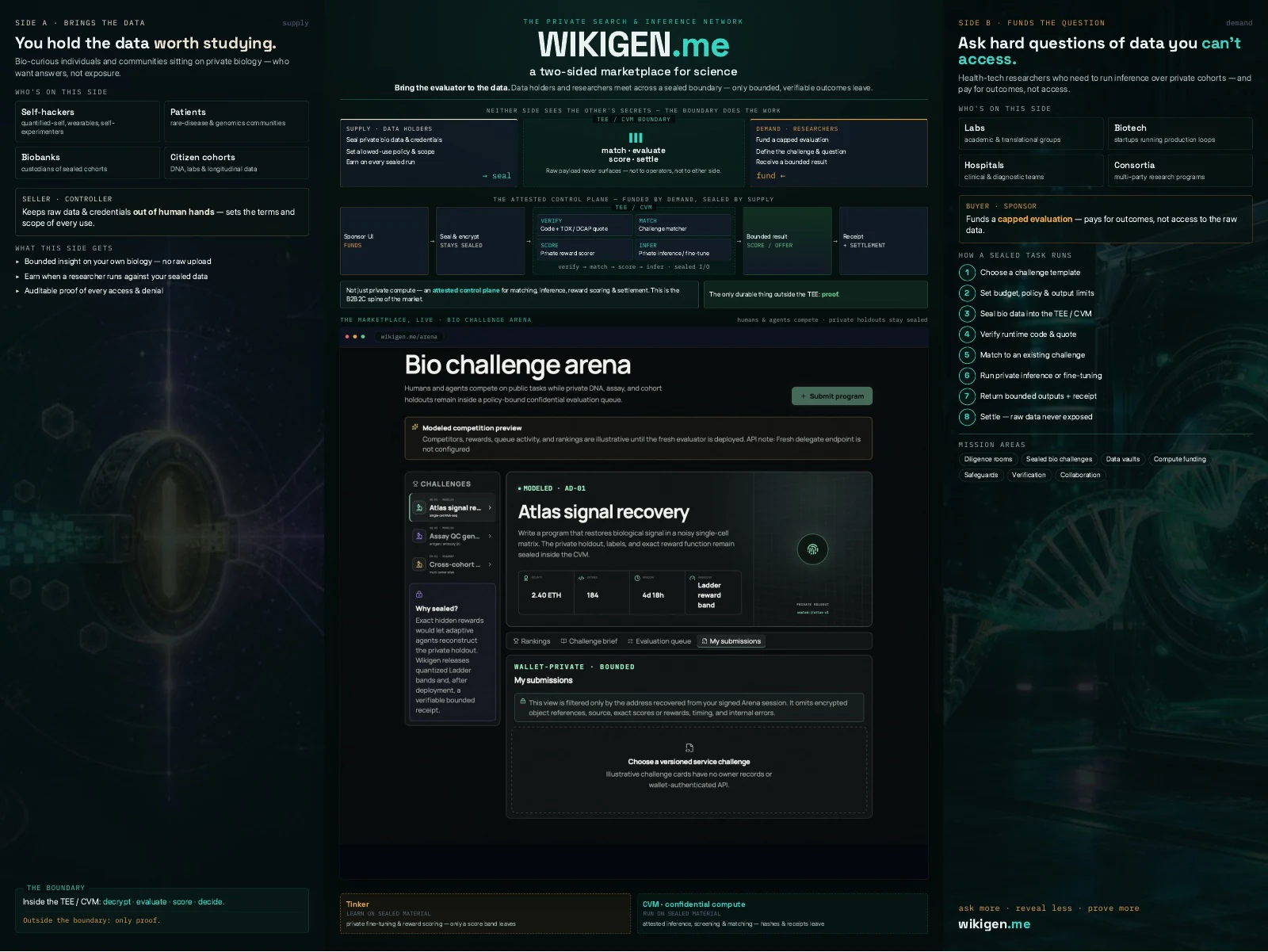
The most valuable biological data is often the least able to move.
WikiGen
Lets researchers ask questions over private biological data, run approved analysis inside a TEE, and release only the agreed result.
Key takeaways
Data owners retain custody while approved analyses run inside a TEE and release only an agreed result.
Private-data collaboration needs a routing and verification layer, not another centralized data lake.
Summary
Patient records, biobanks, proprietary sequences, and credentials are private for legitimate reasons, yet privacy, regulation, commercial sensitivity, and governance can prevent those datasets from being used. WikiGen asks whether the scientific test can move to the data instead.
In the proposed workflow, a biopharma company, research sponsor, or AI scientist defines a question and funds a capped evaluation. A biobank, hospital, or other data owner keeps custody, approves a specific use, and permits the model or scientific workflow to run inside a trusted execution environment.
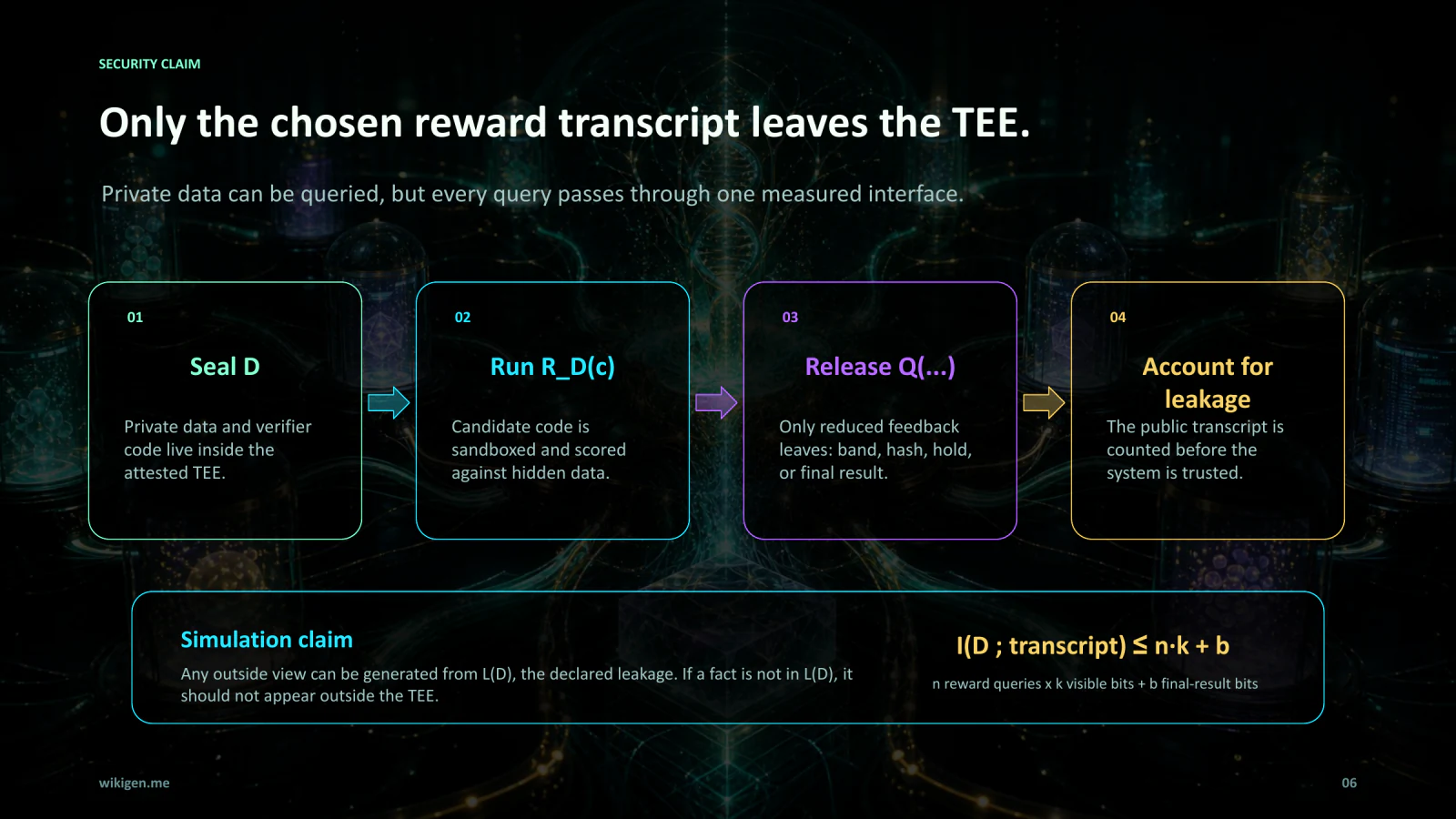
The confidential boundary can access the approved records, but external parties do not receive raw data, unrestricted credentials, or intermediate results. The released artifact is limited in advance to a bounded output such as a score, band, match result, capped offer, or signed evaluation receipt.
The intended two-sided marketplace connects institutional questions with governed datasets while preserving owner custody. The Q&A left the amount of data needed for a meaningful contributor reward unresolved, and the speaker tied value to the urgency and scarcity of the question being answered.
How it works
01
Define a bounded question
A sponsor specifies the scientific question, budget, and permitted output for an evaluation.
02
Keep custody with the data owner
The hospital, biobank, or other owner approves the use without transferring the underlying dataset.
03
Run the approved analysis inside a TEE
The approved model or scientific workflow accesses the data inside a trusted execution environment, with the deployed code and confidential runtime verified.
04
Release only the agreed output
Only an output fixed in advance—such as a score, yes-or-no match, capped offer, or signed receipt—leaves the environment; raw data and intermediate results remain hidden.
Slides
Transcript
My parents tried naming me Victoria Lex, but no one speaks that alphabet that's Polish in Brooklyn, where I grew up, so I go by Wiki. I'm simply trying to help everyone prove more to themselves about themselves and each other as I stem from a biotech background, which relies on think or guess and check on hyperblast. Controls for scientists are like evals for your own evals, and if bias is introduced or a laser is damp for measuring a property, can you proceed? Or do you need to recalibrate the experiment to optimize for trust? Yet, I could have never achieved these feats in bio as I could if it wasn't for this trust protocol, as well as the advancements in sequencing machines that now allow for home whole genome sequencing to be a lot cheaper for humanity and other life.
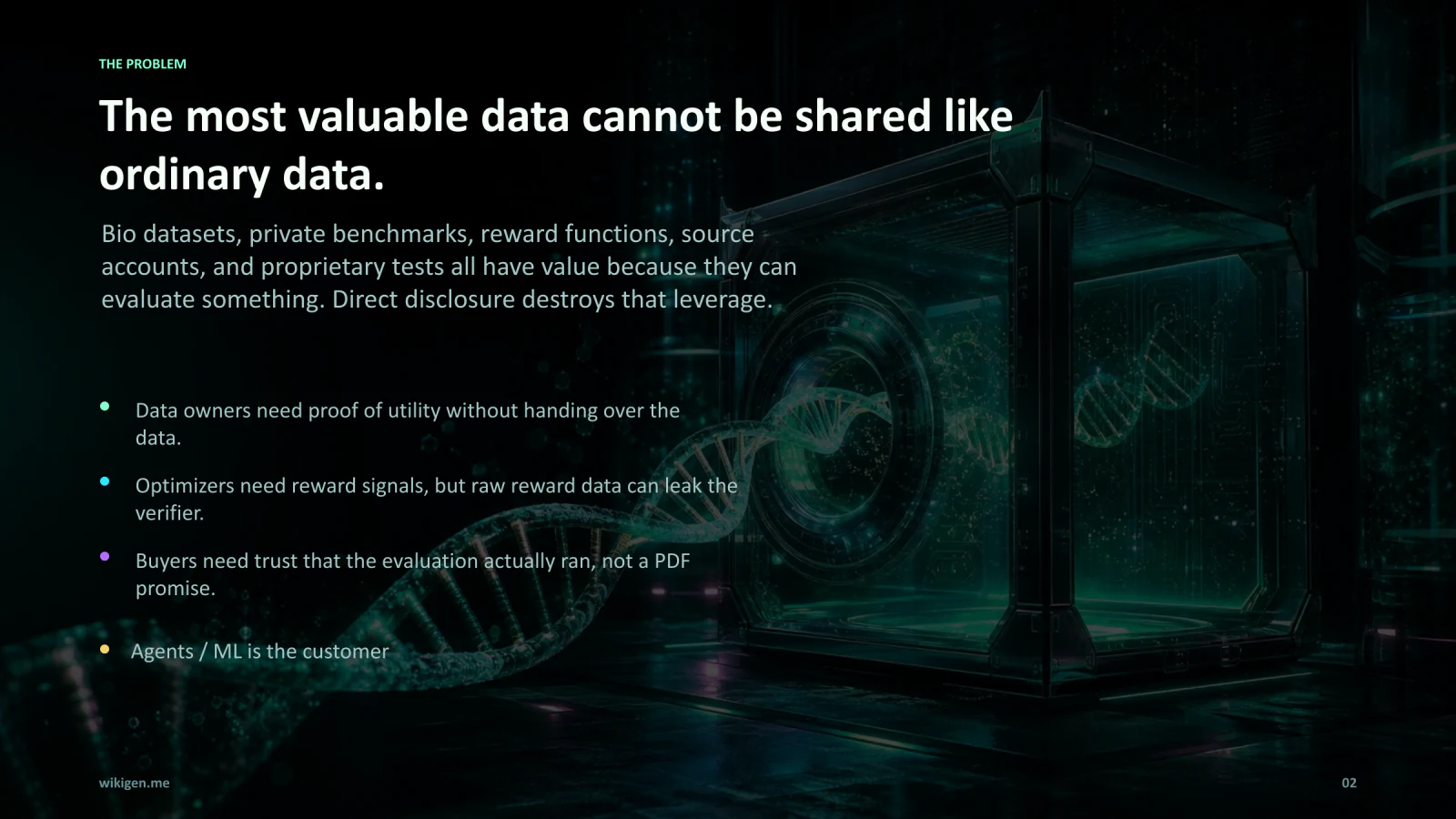
This also relied on compute, bare metal, cloud, or on-prem, so to read the sequence of life. Yet, science has a paradox. The most valuable biological data in the world is also the data least likely to move. Patient records, biobanks, proprietary sequences, your credentials, and this is not a bug. The data is private for a good reason. It is regulated, it is sensitive, it belongs to someone's life. But there is a hidden cost. When data does not move, science also can't. It increasingly depends on data that cannot simply be copied, shared, or uploaded into another company's cloud. Biobanks, hospitals, sequencing companies, researchers, as well as patients may hold valuable data sets, but privacy obligations, commercial sensitivity, and governance requirements often prevent those data sets from being used.
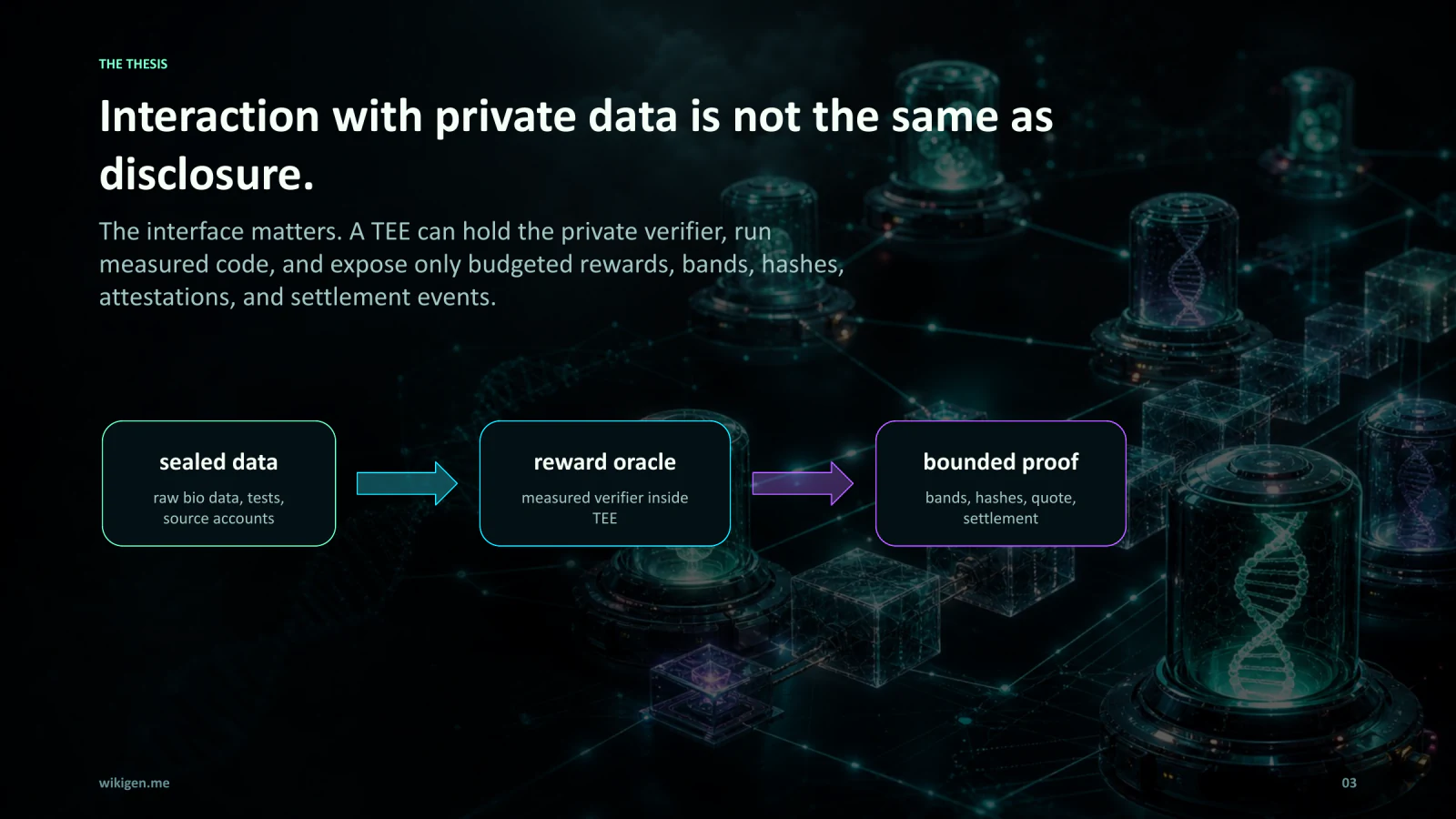
What if data never had to be shared for the science to be tested? So I built WikiGen. I'm building it. The model or a, biopharma company, an AI scientist, or a research sponsor can define a question and funds a capped evaluation. A biobank, a hospital, or data owner keeps custody of the underlying data set and approves a specific use. The model, evaluator, or scientific workflow then runs inside a confidential computing environment, which you all know here as a TEE. Inside that protected boundary, the analysis can access the approved data. So you bring the data to the model, or in this case, an oracle. The verifier A can be swappable. Outside it, nobody receives the raw data, set unrestricted credentials, or intermediate results.
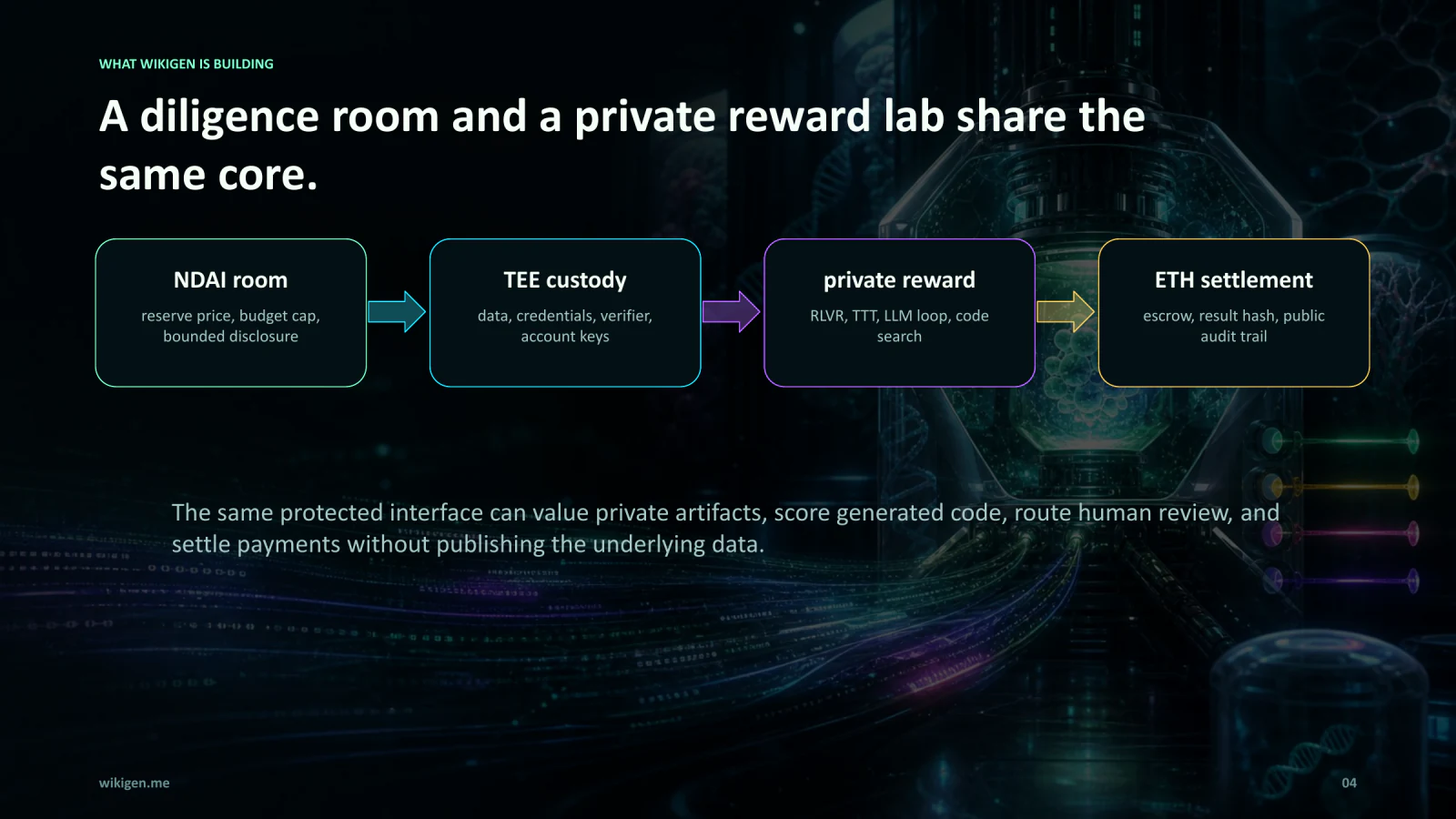
The system releases only the output that was agreed in advance. Perhaps a score, a performance band, a yes or no match, a capped commercial offer, or a signed evaluation receipt. WikiGen supports this workflow through a test of diligence rooms, sealed bio, and DNA, DNA challenges. Governed data vaults, capped compute funding, policy safeguards, collaboration tools, and the verification of both the deployed code and the confidential runtime. This creates a two-sided marketplace for private science institutions can ask valuable questions of datasets that cannot acquire while data owners, researchers, and communities can participate without surrendering custody or control. WikiGen is trying to build not another centralized data lake. We route scientific questions to governed data, run the approved computation inside an auditable boundary, and return only the proof needed to make a decision.
We are the software layer that allows institutions to collaborate around private data, and this is how it works. The view is filtered only by the address recovered from your signed Arena session. It omits encrypted object references, source, exact scores or rewards, timings, and internal errors. The result is a practical path from private data to verified scientific and commercial outcomes without making unrestricted data transfer the price of collaboration. And I'm bringing up T-T-TEE because it's a new way to, when being data constrained, be able to still pursue discovery.
Help us make verifiable rewards a real reality.
Wiki, you talk about giving rewards, ultimately for people's d-data. How much data do you think actually leads to a significant reward? 'Cause I could imagine, like, one individual's data may not be very valuable, and so you have to pool a lot for it to be valuable. In which case, like, what size starts making sense?
Yeah, good question. I've looked into this a bunch. I think that once data is actually having a verifiable on-chain record, it was like zero point zero three cents to zero point ten cents in some healthcare EHR scenarios because of the synthetic data, committee that allows HIPAA to synthesize off your data when you go to an I think that the real answer to your question, though, is the beauty is in the eye of the beholder. So the data is as valuable as someone is affected by a condition that there is no test for them or there is no cure, and they're willing to search further.